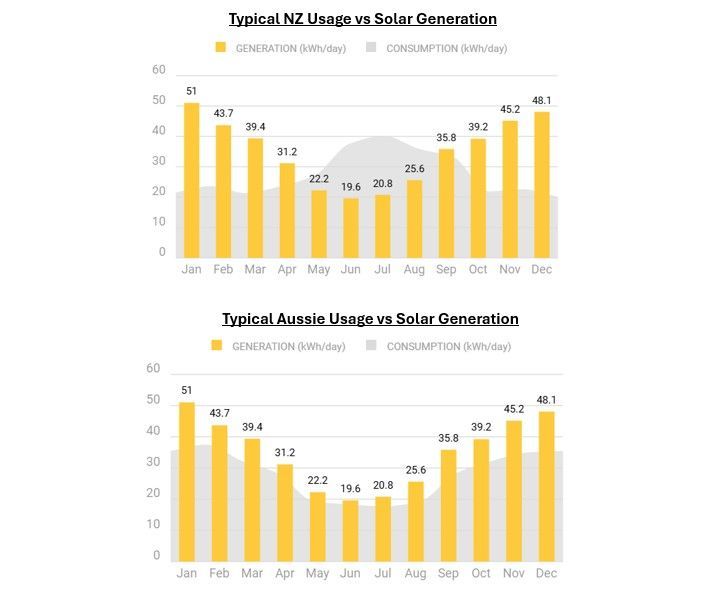
Because the numbers don't lie

Every few weeks someone says something like: “Solar sounds great, but I could probably invest that money better.”


Cool. Let’s actually run that idea through a calculator instead of vibes.


Above in the bright colours is a simple comparison using four very boring, very realistic assumptions:


  • Electricity prices inflate at 4%
  • Term deposits return 2.5% after tax
  • Shares return a conservative 6%
  • Solar systems work as advertised (wild assumption, I know)


No hype. No hero numbers. Just math.


Option 1: Solar Without a Battery


$15,000 upfront (ish).  Maybe a fair bit less or more - depends on the size of your powerbill!


This is the boring, sensible baseline. No batteries. Just panels offsetting grid power year after year.


  • Payback: ~6–7 years
  • 10-year ROI: ~108% 
  • 20-year ROI: ~380%
  • 25-year ROI: ~577%


And here’s the important bit:


That return is
tax-free, inflation-protected, and extremely boring — which is exactly what you want from an investment that lives on your roof.


Option 2: Solar With a Battery


$25,000 upfront (ish).  Could be as low as ~$19,000 or as high as ~$50,000. Depends on bill size.


Batteries aren’t about raw ROI. They’re about:


  • Evening power
  • Resilience
  • Backup
  • Less grid dependence


So yes, the numbers are softer:


  • 10-year ROI: ~50%
  • 15-year ROI: ~128%
  • 25-year ROI: ~388%


Still very respectable — but worth every penny especially when the power goes out.


Option 3: Term Deposit


$15,000 investment, with a ~2.5% annual return after the tax lords take a swig


Safe. Predictable. Comforting.


  • 10-year ROI: ~128%
  • 20-year ROI: ~160%
  • 25-year ROI: ~181%


Also:

  • Doesn’t hedge power prices
  • Doesn’t power your house when the grid is down
  • Doesn’t reduce future bills
  • Not very exciting to talk about over the BBQ


But hey — it feels responsible.


Option 4: Shares (Conservative 6%)


$15,000 invested


Now we’re talking risk.

  • 10-year ROI: ~179%, but probably a fair more or less due to the inevitable market swings.
  • 20-year ROI: ~303% is the typical return based on historical averages.
  • 25-year ROI: ~405% unless your strategy doesn't play out like everyone hopes. Will US shares return in the next 25 years what they did in the past 25 years, or will they track flat like Japan's stock market?


Chances are shares do well long term — no argument there.


But they also:

  • Go up and down
  • Taxed in some measure (not guaranteed)
  • Don’t heat your house
  • Don’t keep the lights on in an outage


Also worth noting: very few people actually sit calmly through 20 years of market volatility without some sleepless nights.


So What’s the Point?


Solar is different.


It’s not just an investment.
It’s not just a home upgrade.
It’s not just a bill reduction.


It’s a capital asset that replaces a guaranteed future expense.


And that’s why it punches above its weight.

You’re not hoping for returns — you’re removing a cost that will absolutely happen, and letting inflation do the heavy lifting for you.


And by the way, we aren't telling you NOT do do term deposits or stocks. Because in the scheme of things, solar is a small investment. Compared to that home you've bought, its a mickey mouse investment. But its totally worth doing.


The Quiet Truth


If you:

  • Have a decent roof
  • Want to take control of your energy costs
  • Care about NZ's economy and want to contribute


Then solar doesn’t need heroic assumptions to make sense.


And the longer you own it, the more awkward it becomes for every other “safe” investment you considered instead.


*This blog includes our totally unprofessional opinions. Take them with a grain of salt. We also haven't factored any increase to the value of your home, which is likely to be somewhere between 1 to 3%.

By looka_production_130270016 December 29, 2025
Solar doesn’t try to beat the market — it deletes a bill that compounds against you.
By looka_production_130270016 December 28, 2025
Cheap solar isn’t cheap because the gear is bad — it’s cheap because responsibility quietly shifts to the homeowner.
By looka_production_130270016 December 23, 2025
Solar panels are so cheap now that even selling excess energy back to the grid at so-called “peanut” rates can still be a very good investment. So let’s talk about solar the right way — not emotionally, not politically, and not based on what your neighbour reckons. Most people say, “Selling solar to the grid isn’t worth it. It’s peanuts.” And our response is always the same: “Nothing wrong with peanuts” Reality is, solar should be considered in the same way all investments are considered. The question is - What am I spending, and what am I getting ? The Abraham Argument (sorry, its a bit of fun) In the book of Genesis, Abraham argues with God over the prospect of saving Sodom and Gomorrah from a terrible punishment. Moses asked god - “Would you save the city for 50 righteous people?” “How about 40?” “30?” “Come on… 20?” “Wait — before you send the fire — how about 10?” That same bargaining logic works beautifully with solar. Let’s assume the absolute worst-case scenario and argue backwards. Check Out Abrahams Sales-Pitch Imagine this: 18 solar panels Cost: $5,000 (totally unreasonable) Annual generation: ~10,000 kWh Every single unit sold to the grid Buyback rate: 17c per kWh Those panels would pay you $1,700 per year in solar buyback credits. No self-consumption. No batteries. No optimisation. Just exports. That’s under a 3-year payback . What do you reckon? Would you do it? Moses - “I’ve got my hands on the stone tablets. And I’m telling you – you can’t get 18 panels for $5,000. But let me ask you…” How Many Donkeys Would You Trade For 18 Panels? If exports alone deliver $1,700 per year in export credits, would you buy 18 panels if they cost: $12,000? (5.9-year payback) $14,000? (8.2-year payback) How about $16,000 and some unleavened bread? (9.4-year payback) ... $16,000 is about what 18 panels cost for most homes. You can forget the unleavened bread. And by the way, Abraham forgot to tell you 👉 $1,700 is the worst this system could save you. Why You'll Save More Than Moses Reckons If you sell solar to the grid, Moses already told you its worth about 17c per kWh (give or take). But the solar you actually use is worth more! It’s worth your retail rate — typically 30–40c per kWh incl GST. That changes everything. Also, If your roof is a decent north-facer with more than a 10° pitch, 18 panels won’t generate 10,000 kWh. They’ll generate more . Good roofs regularly see 11,000 kWh with 18 panels (460w assumed). Great roofs can push 12,000+ kWh per year! Tearing Down The Strawman Argument In the real world: 18 panels typically save ~$2,000 per year without a battery Add a battery and that can push closer to $3,000 per year (book a consult with us to iron out the finer details). So, if Abraham were here, he wouldn’t be arguing about buyback rates. He’d be covering the city in panels to power his DC grain mills and DeWALT power tools. (That's how they built the temple so quick. DeWALT all day)! Because if you can spend $16,000 today and save $2,000 per year minimum , you’re looking at roughly a 7–8 year payback . Over 25 years? That’s $50,000+ in savings when you bake in 3% inflation . Closer to $70,000 if you don't subtract the cost of adding a battery in 5-10 years. But we think the battery will be necessary, because the buyback rates will eventually trend downwards - and you can't expect $70,000 in savings without adding a battery when they become a necessity. The Takeaway Solar exports aren’t the dream scenario. They’re the floor . And when the floor already looks this good… the upside takes care of itself. Disclaimer: You may not be able to sell all of what 18 panels can generate. There are limitations. However - those limitations become entirely irrelevent if your home pulls ~2.5kW of energy during the peak hours between 10 & 2. It's not all that hard to get your home doing this. Pool Pump, Spa, Hot Water Cylinder, Aircon in summer + Fridge and Freezer all add up to a hell of a lot more than a 2.5kW energy demand. And so; the export limit is mostly irrelevant on homes with 18 panels or less. Once you have more than 18 panels, the story changes - but the story is also developing, because more and more networks are unlocking 10kW buyback on one phase, instead of the standard 5kW buyback per phase. And of course, if you have multiple phases (2 or 3) you can get away with 25 - 35 panels and experience zero limits to how much you export.