Cheap solar isn’t cheap because the gear is bad — it’s cheap because responsibility quietly shifts to the homeowner.

There’s a surge of ultra-cheap solar “packages” being advertised in New Zealand right now.
Big numbers. Big batteries. Very small price tags.
And on the surface, it’s tempting.
Who wouldn’t pause at a system that looks thousands cheaper than the rest of the market?
But solar isn’t a toaster. And when you strip away the headline price, what’s left matters a lot more than most buyers realise.
This article isn’t about attacking any one retailer. It’s about explaining how cheap solar packages work, where the risks sit, and why professional solar systems cost more — for reasons that don’t show up on a product page.
One-Size-Fits-All Solar (Why “Bundled at Scale” Is the Core Risk)
Cheap solar packages are almost always bundled at scale.
That means:
- Panels, inverter, battery
- Plus racking, cabling, isolators and accessories
- All pre-selected to suit as many homes as possible
This works brilliantly for selling boxes.
It works poorly for installing solar on real roofs.
New Zealand homes vary massively:
- Longrun, Concrete tiles, Metal tiles, Standing Seam
- Different purlin spacings
- Coastal vs inland wind zones
- Low pitch vs steep pitch
- Simple north-facing vs complex split arrays
Professional solar systems are designed from the roof up.
Racking, fixings and cable paths are chosen specifically to ensure:
- Long-term watertightness
- Structural strength under uplift
- Correct panel spacing and airflow
- Clean, compliant cable management
A bundled kit can’t do that properly. When a one-size-fits-all kit hits a non-standard roof, installers are forced to:
- Add missing components
- Modify layouts on the fly
- Or “make it work” under cost pressure
This isn’t theory — it’s exactly what many buyers report happening in real installs.
The Warranty Trap Most Buyers Miss
This is the most important point in the entire discussion.
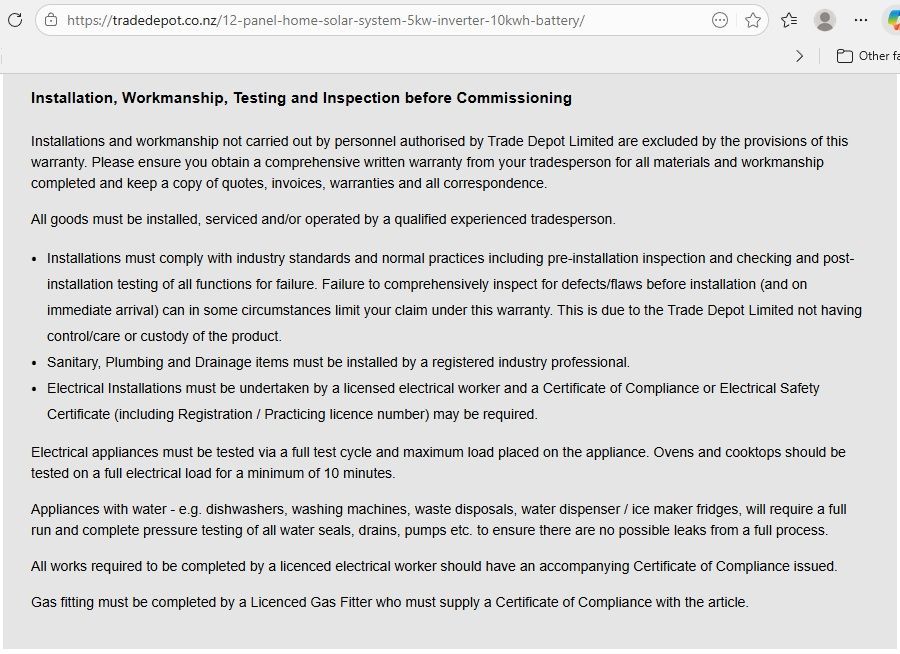
If a homeowner does not use the retailer’s approved installer, the system warranty is typically voided.
Take Trade Depot as an example. We've snipped some of their general terms in the images at the bottom of the page.
As a work around, retailers often suggest that customers:
“Obtain independent warranty documentation from their installer”
That sounds reasonable — until you've explored how solar warranties actually work.
A proper solar warranty usually covers:
- Product defects
- Workmanship
- Labour to remove and reinstall faulty components
- Freight costs
- Disposal of failed equipment
Here’s the reality:
No solar installer in New Zealand will provide full end-to-end warranties for equipment they did not supply.
And that’s not bad faith — it’s commercial reality.
If an installer didn’t:
- Design the system
- Select the equipment
- Source it through their suppliers
- Control shipping and handling
…they can't afford to stand behind it long-term. The risk is too large.
The result? Hardware warranties may exist on paper, but the financial and logistical risk of failure often lands back on the homeowner.
The Headline Price Isn’t the Installed Price
This needs to be crystal clear.
The advertised prices for many cheap solar packages do not include installation.
Typically, the price covers:
- Panels
- Inverter
- Battery
- A generic accessories bundle
Installation is:
- Quoted separately
- Outsourced to contractors you can't choose
- Or left entirely to the homeowner to organise, without clear communication that independent labour only installers will likely leave your product warranties null and void.
If a consumer does choose an independent labour only installer (instead of the box moving solar wholesalers 'trade partner'), once you add in the additional costs that spring up, the price gap between a real solar company and the box mover narrows very quickly.
Costs that often spring up after you purchase a one size fits all solar package:
- Different fixings may be required to what was supplied
- The cabling provided may not be compliant
- Railing may not be of the highest quality. Should last 5 years, but maybe not 20+ . The client may need a whole new set of rails.
- The final array design may not be possible with the provided equipment (MPPT Limitations).
- Fire proofing material may be needed if the battery location isn't fixed to a garage
Why Professional Solar Costs More (and What You’re Paying For)
When you use an established solar company — or a qualified sparky who specialises in solar — you’re not paying for a box of gear.
You’re paying for:
- Expert system design, tailored to your roof
- Correct racking selection, not generic hardware
- Long-term watertightness, not short-term fixes
- Structural design, appropriate for NZ wind zones
- Electrical compliance, done cleanly and once
- Performance optimisation, not guesswork
- Battery and backup integration, if applicable
- One accountable warranty, covering product, labour, freight and responsibility
In short - You’re paying for a system that’s still safe, dry, and performing properly decades from now.
A Simple Way to Think About It
Cheap solar isn’t always cheap.
Often, it’s just
unbundled risk — handed quietly back to the homeowner.
If you understand that trade-off and accept it, fine.
But it should be a conscious decision, not a surprise uncovered after the install.
*This article does not allege wrongdoing by any specific company. It reflects commonly observed practices by a small group of solar-package-providers, customer-reported experiences, and standard solar installation practices in New Zealand. Buyers should always review warranty documentation, installer credentials, and compliance responsibilities before purchasing any solar system.