If you’re thinking about a battery now or soon, a hybrid inverter is the right move, and the only move you should make.
If you’re not, a hybrid inverter is the wrong answer — and likely an expensive mistake.
This isn’t theory. It’s what we’ve watched happen in the NZ market, repeatedly.
The Two Rules (Read These First)
Rule #1: If you want a battery now or soon → get a hybrid inverter
Simple.
If the battery is part of the project today, or genuinely within the next 12–18 months, then:
- Hybrid inverter + battery from the same ecosystem
- One warranty stack
- One support pathway
- Technology that’s designed to work together
Done properly, this is clean, logical, and future-proof.
Rule #2: If you don’t want a battery now or soon → don’t get a hybrid inverter
This is where things go sideways.
A hybrid inverter installed without a battery is:
- An inverter you’re not fully using
- A gamble with the extra spend of ~$1000 to ~$5000
- Locked into unknown future battery partnerships
- Exposed to technology drift, and firmware dead-ends
Hybrid inverters are not neutral placeholders. They are opinionated pieces of hardware that bank on future battery partnerships, software support, and a solar company that's committed to stocking old hardware for an un certain quantity of buyers.
Chances are, the stars won't align in your favour.
What Actually Happens in the Real World (NZ Context)
Without naming installers as villains — because this is an industry-wide issue — let’s look at a very public pattern that is conveniently left out of most Hybrid-Inverter Sales Pitches.
To explain the pattern, lets look at one large NZ solar retailer. Over the past decade, this one solar retailer has sold and promoted multiple different battery brands, including:
- Q-cells
- BYD
- Panasonic
- LG
- And today: Two other totally different brands.
Their battery record isn't out of the ordinary, because its happened everywhere. Here's why:
- Battery manufacturers exit markets
- Safety recalls occur
- Firmware support ends
- New chemistries outperform old ones
- Commercial partnerships change
The uncomfortable part
Customers who bought hybrid inverters for batteries that:
- Are no longer manufactured anywhere
- Are no longer supported locally
- Cannot be expanded
- Cannot be replaced like-for-like
…don’t get a free do-over.
They'll have to
chuck their hybrid inverter
and start all over again. Happens all the time.
The Missing Piece: Your Installer Won’t Stand Still
Lets say you go Hybrid, and wait a few years. Even if a compatible battery still exists in 2–3 years, it’s increasingly unlikely that:
- The model you need is still coming into NZ
- Your original installer still sells it
- It's as good as the new stuff on the market
Installers evolve quickly. Brands change. Supply agreements end. Sales teams move on.
So when a customer comes back years later asking about adding a battery, the response is often something like:
“That unit isn’t something we sell anymore. You could try calling X — they might be able to help.”
That’s not bad intent — it’s commercial reality.
😬 Worst Case Scenario (and It’s Not Fiction)
Imagine this.
You install a hybrid inverter in 2026, battery‑ready, just in case.
By 2029, you finally decide to add a battery.
You’re lucky — a compatible battery still exists. But:
- Your original installer no longer sells it
- Another installer agrees to help, cautiously
- The system now spans two installers, two contracts, two responsibility lines
Fast‑forward again to 2032. The inverter fails (totally possible).
Consider this:
- What are the chances the supplier of your inverter honours the warranty? After all; someone else has been mucking around with it when the battery was added.
- Even if the warranty is honoured, will there be a like for like inverter that still talks to your battery?
This is how homeowners end up replacing perfectly good batteries well before their time.
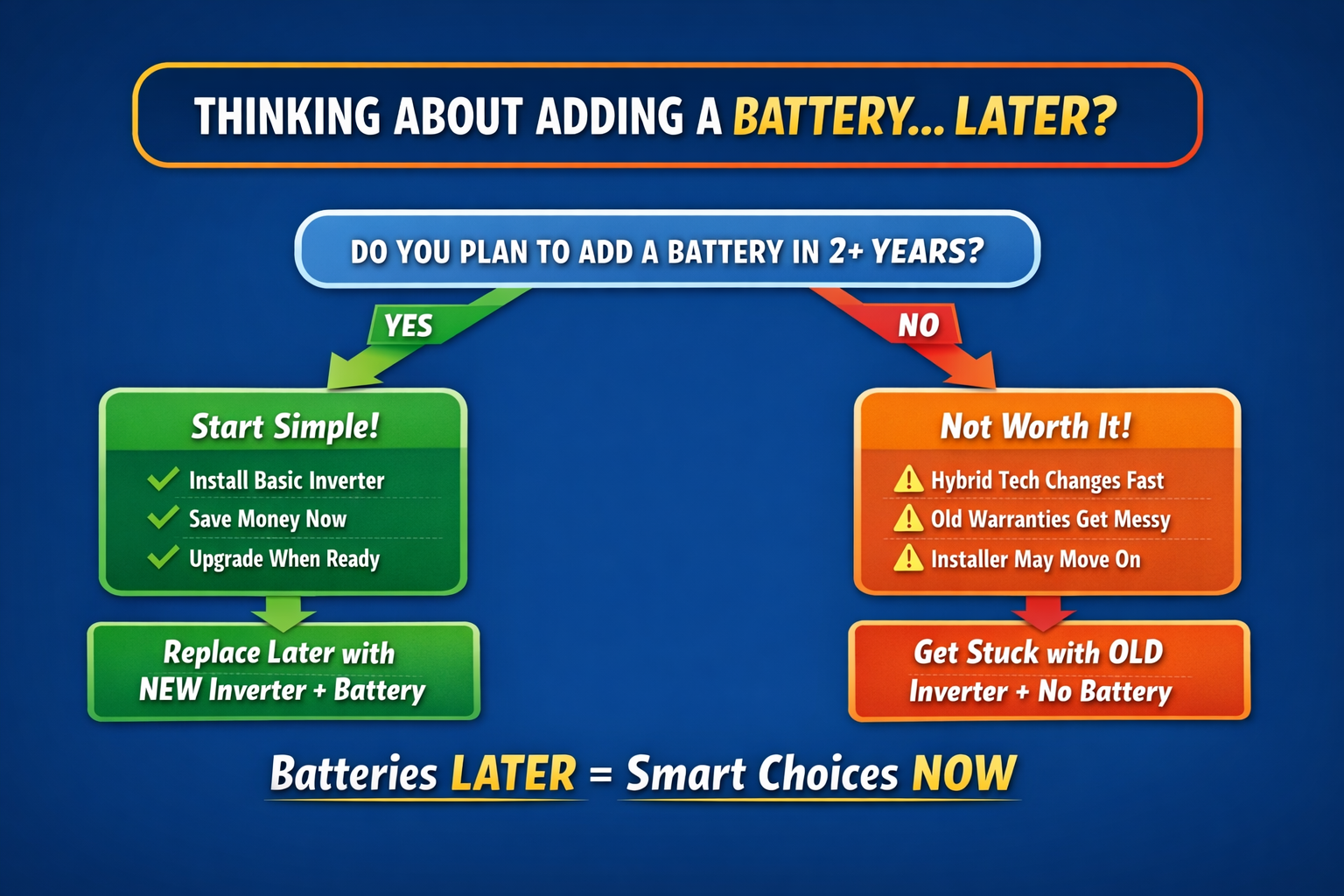
The Smarter Play If Your Battery Is 2+ Years Away
If you don’t want a battery now, here’s the play we recommend — every time:
Install a simple, proven string inverter
Brands like:
- GoodWe
- Solis
- SolaX
- Sungrow
These are:
- Cost‑effective
- Reliable
- Well‑supported
- Excellent at one job: turning DC into AC
The best part? You won't be kicking yourself when they get ripped and replaced for the latest inverter and battery technology.
Wait for the deal of the century
Let:
- Prices drop
- Technology mature
- Winners emerge
We're not saying don't get a battery - we're just saying - if you're not getting one yet, here's how you can save yourself a few grand and a ton of heartache.
When you actually want a battery — replace the inverter
Yes. Replace it.
Why?
- Battery + inverter start their life together
- One ecosystem, composed of market leading technology from ~2030
- One warranty timeline
- One support pathway
- Modern safety standards
- Modern technology
Counter‑intuitively, this often costs less long‑term, and performs way better than forking out now to future proof an upgrade to an old model battery.
The SigEnergy Honeymoon Phase (A Cautionary Note)
Right now, SigEnergy is everywhere. It's the latest and greatest, and the market is in love with it.
Here's why:
- Clean, modern hardware design
- DC to DC car charging with proven vehicle to home / vehicle to grid (V2H, V2G)
- All‑in‑one architecture that installers love
- Fast commissioning
- Incredible AI integration
- The best mobile app, hands down.
SigEnergy is the 'iPhone moment' for the solar industry. It's everything we've been waiting for, in one stunning package, and for a great price!
We've got nothing against it, and can confidently say that 50% of our battery sales are SigEnergy.
The problem isn’t SigEnergy — it’s just that it comes with the same old sales pitch.
... This is the greatest ... Here's why you need it ... You can add a battery to it ...
The uncomfortable reality
SigEnergy is in its honeymoon phase. And like all 'golden child' products before it, it's being sold with relentless vigour and energy.
Don't believe us? Even serious issues — including recalls over well‑publicised fire‑risks — have largely been brushed aside or minimised in sales conversations. That’s not because installers are dishonest; it’s because when the industry falls in love with a new platform, risk gets emotionally discounted.
Until something else comes along...
What's really scary is the special attention always comes right before:
- Support expectations drift
- Product lines change
- Ecosystems fragment
- And “the next big thing” arrives
None of this means SigEnergy will fail. We aren't crystal balling anything - far from it.
Maybe SigEnergy is here to stay and in 5 years from now, everyone who bought the all-in-one SigEnergy Energy Controller (Hybrid) will have no issues getting the modular batteries they promised would be available.
But what if they can't?
History doesn’t repeat — but it absolutely rhymes
The hard truth is this:
Solar companies have always believed they're selling the best hotcakes in town.
But technology cycles move faster than installer loyalty.
Almost every solar company who told us in 2024 that 'Sungrow is the best' and 'wouldn't sell anything but Fronius'; are now selling SigEnergy exclusively.
Most of the companies we work with are supporting their clients from 2024 with battery upgrade paths. But that's only ~2 years back.
How about the clients from 2020? Not many of them can get the latest and best value battery upgrade from the installer who sold them a Hybrid inverter.
The Exception: Surprisingly Good Value in the 48V Space
There is one meaningful exception to everything we’ve said above.
If you’re comfortable with cheaper, simpler equipment — the kind that’s less fashionable, less heavily marketed, and not pretending to reinvent the laws of physics — then it’s worth looking at the 48V battery ecosystem.
What makes 48V different
48V systems aren’t new. In fact, that’s the point.
They’re built around a long‑established electrical standard that:
- Isn’t brand‑locked
- Isn’t trying to reinvent the wheel
- And isn’t dependent on one manufacturer’s vision of the future
As a result, 48V batteries tend to be:
- Safer (lower voltage, lower fault energy)
- Electrically conservative
- Easier to replace or substitute over time
There will always be 48V batteries available.
That alone makes them fundamentally different to high‑voltage, tightly coupled hybrid ecosystems (Like SigEnergy, Sungrow, Fronius, etc).
Deye / Sunsynk: same DNA, different badge
A good example is the Deye / Sunsynk ecosystem.
These inverters are widely sold under different brand names in different regions, but at their core they share the same underlying platform. They’ve become popular not because they’re glamorous, but because they’re:
- Flexible
- Battery‑agnostic within the 48V world
- And brutally good value for money
They don’t promise the future or try to set new standards, BUT - they do their job without a hitch, which is exactly what you want if your objectives are less about gizmos and more about have solar and grid resilience for a super sharp price.
Solis + Dyness PowerBox G2: boring (in a good way)
Another standout pairing is Solis inverters with the Dyness PowerBox G2. This is a common set up in NZ and if you want a sharp quote - we can get it for you.
This battery doesn’t get much hype — and that’s exactly why it’s interesting.
- 48V architecture
- 1C charge/discharge capability
- Unlimited cycles rating
- 14.4kW peak discharge rate for 120 seconds
- Very sharp pricing compared to premium brands
No slick marketing story. No ecosystem lock‑in narrative. Just a battery that does what it says on the tin.
Such great value - perfect for the small to medium home
48v setups are such good value that consumers can legitimately entertain themselves by choosing:
- The highest priced inverter from a heavy weight like Fronius - 5kW Gen 24 inverter without a battery (~$5000 installed).
OR
- A great value 48v solar and battery setup like a Solis S6 with a 5kWh Dyness battery (~$5000 installed).
See the point? One system has a battery, and one does not. It's not rocket science.
Why this works as an exception
48V systems succeed where hybrid‑without‑battery systems often fail because:
- The battery doesn’t rely on one inverter brand surviving forever
- The inverter doesn’t assume one specific battery roadmap
- And replacement paths remain realistic even years later
The trade‑off is honesty. You’re not buying 'the latest tech' on the market. You’re buying a good, cost‑effective system that’s unlikely to leave you stranded. And for some clients — especially value‑driven ones — that’s a perfectly rational choice.
Why Brokers Think Differently Than Installers
Solar companies make money by installing what exists today.
We exist to do right by our clients, without showing loyalty to any promotion, brand, or solar company.
The Bottom Line (No Fluff)
- Hybrid inverter + battery now or soon? → Yes.
- Hybrid inverter “just in case”? → No.
If your installer is pushing a hybrid inverter without a clear, committed battery plan:
- Ask which battery
- Ask for how long
- Ask what happens if that battery disappears
If the answers are vague — walk.
At Equity Solar Brokers, our job isn’t to sell you hardware. It’s to stop you buying the wrong hardware at the wrong time.
Sometimes the smartest future‑proofing move… is not trying to future‑proof at all.
Sources:
LG battery complaints / failures
https://www.reddit.com/r/solar/comments/1le5ixi/dont_buy_lg_solar_battery_two_dead_in_five_years/
https://www.reddit.com/r/solar/comments/1gjtk5t/
LG Solar Batteries catching fire
Panasonic exiting residential solar & battery market
https://www.pv-magazine.com/2025/05/01/panasonic-exits-solar-and-battery-storage-ending-decades-long-journe/
Reddit discussion reacting to Panasonic exit
https://www.reddit.com/r/solar/comments/1ka699r/
Qcells battery compatibility / dead-end upgrade paths
https://forum.cleanenergyreviews.info/t/qcells-compatibility/3321
Qcells battery business winding down (AU market, relevant to NZ)
https://www.solarquotes.com.au/battery-storage/reviews/qcells-review.html
Battery + inverter compatibility is not universal
https://www.uspower.us/blog/can-you-use-qcells-solar-panels-with-non-qcells-batteries
Reputable brands ending support for hardware not even a few years old, and the equipment supplier not rectifying it out of their own pocket (as they should)
https://www.facebook.com/share/p/1DP7Sedh9X/