Chasing buyback rates while ignoring winter peak prices is how good solar savings quietly disappear.
Everyone’s talking about buyback rates.
Meridian this. Octopus that.
And yeah — buyback rates matter.
But most people are obsessing over the wrong side of the power bill.
Because while everyone’s chasing an extra few cents for exported solar, they’re ignoring what they’ll still be paying for grid power on cloudy days, and during winter evenings — when solar simply can’t keep up.
And here’s the uncomfortable truth:
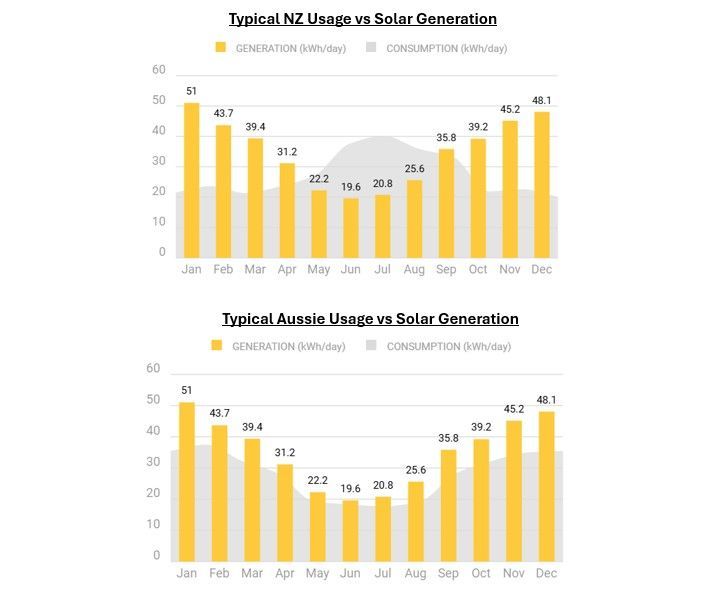
Solar is unlikely to cover your big winter loads.
What solar actually does well (and what it doesn’t)
Solar is brilliant at smashing summer power bills.
Even without a battery, many homes see close to 90% off their monthly bills.
Winter is a different beast.
Even with a battery, solar generally:
- Reduces winter bills by 40–50%, not 100%
- Leaves you buying a decent chunk of power from the grid
- Especially between 5–9pm, when families actually use electricity
So once you install solar, it becomes critically important that the power you still buy from the grid — mostly in winter — is priced sensibly.
The buyback trap
The highest solar buyback rates come from retailers like
Octopus and Ecotricity.
Sometimes their overall pricing stacks up nicely. And sometimes it really doesn’t.
Consumers are signing up to these plans in droves; mainly motivated by the high solar buyback rates.
Compared to the flat “anytime” pricing offered by much of the market, these plans tend to come with peak rates 30–40% higher than what you'd pay at the same time on an 'all the time / anytime' rate. IE; 50c between 5pm to 9pm with a 'peak / off peak plan' but only 35c on an all-the-time plan.
That would be fine... If your solar and battery could actually cover your winter evening usage. But most solar systems can't. So consumers are left buying peak power at 50c per kWh, when they could be paying 35c per kWh.
When peak pricing doesn’t matter
(The seriously oversized system that consistently generates enough for 7am - 9pm in winter)
Let’s say your home uses 12,000 kWh per year.
Ballpark numbers:
- 1,600 kWh/month in the 3 coldest months, and around 800kWh/month in the 9 warmer months.
- That’s about 50 kWh per winter day
- Around 35 kWh of that is likely used between 7am and 9pm
Unless your roof is a perfect 35° north-facing unicorn, you’d need roughly:
- 17.5kW of solar (35+ panels)
- A 20kWh battery
Cost? Around $50,000. And this system would handle peak pricing nicely.
But it would also:
- Smash into export limits in summer, unless your home is 3 phase.
- Waste energy because of the buyback limits
- Leave a huge hole in your pocket or home equity.
The upside?
You'd be able to dance around those peak rates like they're the piggy in the middle.
And after 9pm, you'd enjoy the 'super off peak' or 'night rates' — which can be 30–40% below the standard anytime rates.
Sounds great, but reality is - 12,000kWh of usage is typical. $50,000 is not.
And chances are, you're not looking to spend $50,000 on solar?
When rates really matter
(The system most people actually get)
Most homes install solar to:
- Eliminate summer bills
- Cut winter bills by 40–50%
That means during the coldest three months, you’re still buying roughly half your power from the grid.
So if your system isn’t covering winter evenings (it probably isn’t), then why on earth would you pay 50c/kWh when you could be paying 35c/kWh?
This is where we hear the same line over and over: “We use most of our power in winter evenings and want solar + a battery to ensure a warm house without the bank-breaking power bills.”
And our response is always: “Cool. Solar can help, and let’s make sure you don’t get ripped off during those peak hours.”
Sometimes we recommend those peak / off peak power plans - because often the savings equation works in your favour, even during winter. But that's not the rule. If a solar company is out there pushing one power company over another, without applying some serious thought to the rates you are on now, and the rates you'll be on with solar, you have to ask -
Does this solar company truly understand how changing power companies can affect my month to month energy costs?
“What about charging the battery from the grid?”
Good question.
In practice? It quietly destroys your battery warranty.
Even the latest Tesla Powerwall states that once you charge from the grid:
- You lose the unlimited cycle / 70% capacity guarantee
- You’re capped at 10kWh of total daily cycling
- Exceed that, and your warranty ends once you hit 37.8 MWh of throughput
Do the maths:
- 37,800 kWh over 10 years
- ≈ 10.3 kWh per day
Increasing the tire-wear on your solar battery from grid charging may decrease your power bills by a further 10%, but you can also be certain:
Grid-charging your battery reduces its lifespan and its warranty.
Better to design a system with a reasonable evening power price in mind so Peter doesn't get a chance to rob from Paul.
The final word
If you’re like most people, your home barely uses power while you sleep. So on an anytime rate plan, don’t stress about the ~35c anytime rate.
When you’re earning 17–20c on exported solar during the day, the real win is knowing your 5–9pm power price isn’t undoing all that good work.
Because remember:
- In winter, solar systems perform at roughly half their summer output
- At the same time, homes often use twice as much energy
Get the winter evening rate right — and the buyback rate becomes a nice bonus, not a trap.
Need our help on solar design and power rate comparisons? Leave your deets below 👌
Rates you should know about:
*Our comments are based only on our opinion, may not be factual, and are only relevant to residential offers.
| Notable Providers | Buyback rate | Things you should know | Eligibility |
|---|---|---|---|
| Octopus | 17c all the time, or 10c off peak / 23c on peak | Sometimes a very high peak export rate is advertised. However, it must always be compared to the peak power usage rate. Why sell for 40c if it costs more than that to cook a chicken? | 10kW inverter or less |
| Power Edge | 17.39c + GST | The + GST isn't guaranteed, but the general rule is - if your annual power account isn't a net negative, then you keep the GST. This is achieved by Power Edge applying the credit to invoice before GST is calculated, not after it. | 10kW inverter or less |
| Meridian | 17c all the time | Their 'anytime rate' and daily charge tends to be very competitive. Most homes use less than 8,000 kWh per year once they have solar, and become eligible for the ~$1.50 daily charge on offer by Meridian. They also lock in your rates for 2 years! Great offer. | 10kW inverter or less |
| Powershop | 13c all the time | Their rates are all over the place. Not suitable for those on a tight budget, or who aren't prepared to load up the powershop app on a weekly basis to lock in 'power packs' | Residential systems under 30kW |
| Genesis | 12.5c | Their day and night rate for EV customers is awesome! | Residential systems under 30kW |
| Ecotricity | 16c off peak 21c on peak | Rates tend to be quite competitive. As at Feb 2026 they tend to be the most competitive. | Residential systems under 30kW |