
SigEnergy vs Tesla
An Apples-to-Apples Comparison for Real Homeowners
Every battery comparison on the internet is rattling off the same stuff.
“SigEnergy is stackable. It has a DC car charger. It’s the best all round”
We agree with most of it. But equally, we think the high level comparison isn’t fair to either brand.
It’s just not black and white.
And, there are many other great options in the market. SigEnergy and Tesla have their fair match from Sungrow and Fronius.
Nonetheless… 9/10 people end up comparing SigEnergy vs Tesla. Don’t shoot the messenger. That’s just what’s happening out there.
Despite all of YouTube covering the idea, nobody has actually answered the question: "If I've got $30,000 to spend, which system should I get?"
Those questions are gold. And that’s what you probably need an answer to.
Here’s a teaser:
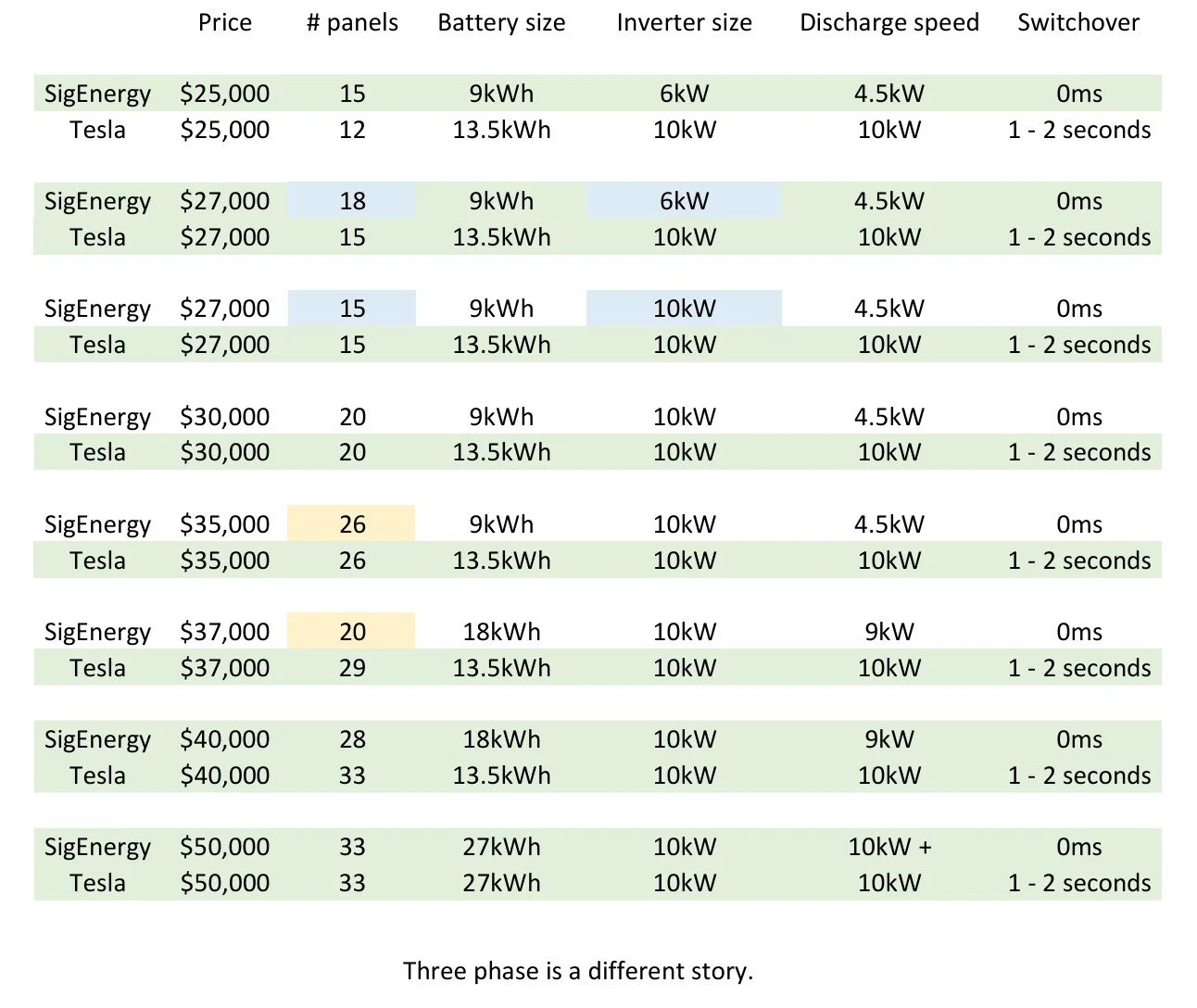
*These prices are indicatives only, based on what we are seeing in the market, on a ‘perfect roof’. Complex jobs could be up to 30% more on price.
Before we go any further… It must be said. Tesla is a Single Phase option. SigEnergy offers 3 phase, and 2 phase gear. So, the comments in this blog are just for Single Phase customers (who represent 4/5 residential solar installs). 9/5 times, Tesla is NOT recommended on 2 and 3 phase sites. Read more here.
We don't install Tesla.
We don't install SigEnergy.
We don’t install anything!!!
And we don't get commission from any of these brands.
But we procure, and compare solar quotes everyday.
Most people have been on Youtube and seen that SigEnergy is set up for Vehicle to home, and Tesla is made to operate in flood waters.
The features aren’t hard to find. But when sales people are spinning their spider web, the caveats are impossible to distinguish.
So for this comparison, we're ignoring the fancy features.
We're ignoring the marketing.
We're ignoring the shiny brochures.
This is a straight-up value comparison.
Solar.
Battery.
Backup power.
Price.
Before We Start: The Three Numbers That Actually Matter
There are dozens of specifications you should consider.
But in this article, we tackle the simple ideas.
1. Solar Capacity
More panels, more solar.
More solar, more savings.
2. Battery Capacity
This is how much energy the battery can store.
A 13.5kWh battery stores 50% more energy than a 9kWh battery.
If your goal is running the home overnight from stored solar energy, battery size matters.
3. Battery Discharge rate
This is the specification most salespeople mysteriously forget to mention.
Battery capacity tells you how much energy is available.
Discharge rate tells you how much of it you can use at once.
A Tesla Powerwall can deliver around 10kW continuously.
A SigEnergy 9kWh battery can deliver around 4.5kW continuously. (Which is half of its capacity. Hence it is a 0.5C battery).
An 18kWh SigEnergy battery can deliver around 9kW continuously.
A 27kWh SigEnergy battery delivers 13.5kW continuously.
The $25,000 Budget

Verdict: Draw
This is genuinely difficult.
The SigEnergy system gives you:
More solar generation
Better savings potential (probably, but not guaranteed when you factor in AI savings)
The Tesla system gives you:
50% more storage
More than double the backup current
A much larger inverter
An extra solar panel input (MPPT). This unlocks a whole new roof face for extra panels.
If your goal is reducing power bills, the Sig system makes a compelling case.
If your goal is backup capability and future-proofing, Tesla starts looking very attractive.
Call this one a draw.
The $27,000 Budget (Round One)

Verdict: Draw. Maybe…
Why?
A couple of extra grand gets you a few more panels on both systems.
The problem?
The SigEnergy system is tapped out. You can’t really add more panels, so why would you want to add more batteries?
Meanwhile Tesla still gives you:
The larger battery
The larger inverter
More backup power
Another input/MPPT for panels on an entirely new roof face.
The $27,000 Budget (Option Two)

Verdict: Tesla
Same $27,000 as the last comparison, but instead of putting 3 extra panels on $25,000 SigEnergy system, you’re upgrading to the 10kW SigEnergy inverter.
This is the cleanest comparison in the entire article.
Same solar.
Same inverter size.
Same price.
Tesla simply provides:
50% more battery storage
More than double the discharge capability
Unless you dislike the CEO, Tesla wins comfortably.
But, you should choose SigEnergy if:
You want to add a 4th group of panels, as SigEnergy has 4 panel input (MPPT).
You want to stack up to 18kWh of storage, but not 27kWh (Tesla has that sorted, and for cheaper)
You’re keen to pay a hefty price for the DC car charger and vehicle to home functionality
You don’t want to support a trillionaire 🤜🤛
The $30,000 Budget

Verdict: Tesla
Same solar.
Same inverter.
Bigger battery.
Higher discharge rate.
Easy one.
Tesla wins.
But again… If you can’t tolerate the rocket man, that’s fair enough.
The $35,000 Budget

Verdict: Tesla
Again, the comparison is straightforward.
The systems are effectively identical except Tesla gives you substantially more storage and significantly more discharge power.
However - Most people happy to spend $35,000 are probably prepared to spend another $10,000 later down the track. So… keep reading!
The $37,000 Budget

Verdict: Tesla
This is where things get curly.
If you want that second 9kWh SigEnergy battery module, the money has to come from somewhere! And often, that means buying less panels.
Of course, you could consider adding a 6kWh battery module on top of the 9. But… The 6 costs about $5500. Why not get another 9 for just $7000?
Seems the short answer is… Don’t spend $37,000 on SigEnergy? 🤷♂️
… You need enough panels to charge the extra battery module. Otherwise, why bother?
*Unless you are charging the battery using off peak power. But the difference between on peak an off peak is only about 25c. That’s a daily saving of $2.25, assuming you charge a 9kWh battery the whole way, every day, using off peak power, and then discharge it into the peak times!
$2.25 per day = $821 per year in savings, best case scenario.
The $40,000 Budget

Verdict: Draw
Finally, we're back to a genuine contest.
Tesla gives you:
More solar generation
Slightly higher discharge capability
SigEnergy gives you:
33% more battery storage
No rocket man
Both options are great!
But then we have to ask… Which system could last 20 years? Will SigEnergy age like a 2018 Nissan Leaf, or a 2018 Tesla model 3?
Nothing wrong with the Tesla.
The $50,000 Budget

Verdict: Draw
At this point the two systems largely converge.
Same solar.
Same storage.
Similar backup performance.
You're no longer comparing value.
You're comparing ecosystem preference, installer preference and future plans.
The Elon Question
Let's address the elephant.
Or perhaps the rocket-shaped trillionaire.
It’s love and hate, right?
Maybe you’d sell your neighbours children before supporting the guy.
Yup, totally get it.
But our position is simple.
We're solar brokers.
Not political commentators.
Whether you think Elon is a genius, a menace, or an alien (highly likely), the Powerwall 3 is still a great product at a decent price.
Wait... What About Sungrow and Fronius?
Good question.
Because if we're talking premium battery systems, Tesla and SigEnergy aren't the only brands worth considering.
Sungrow
If Tesla and SigEnergy are getting all the headlines, Sungrow is quietly getting on with the job.
And doing it very well.
Actually, we think there’s a strong chance Sungrow systems could prove to be more reliable than SigEnergy.
Think… 20 years. Who will be the last battery standing?
Wouldn’t be surprised if it was Sungrow, or Fronius.
Excellent reliability.
Excellent backup capability.
Slightly higher discharge rating
Strong pricing.
Great installer support.
Many of the best-value premium systems we review every year are based around Sungrow. (5.6kW discharge on a 9.6kWh SBR battery. 0.6C).
Sungrow is the forgotten child. Bit of a shame, really.
Fronius
Fronius is fantastic.
Ultra reliable.
Exceptional engineering.
Fronius is a bit like the Toyota Land Cruiser.
You don't buy it because it's cheap.
You buy it because you expect it to keep doing its job long after you've forgotten what it cost.
So Which One Wins?
Back to SigEnergy vs Tesla, because thats what most of the market is asking, and what this blog is about.
Looking purely at value, Tesla has a surprisingly strong case.
In fact, from roughly $27,000 through to $37,000, it's difficult to build a genuinely compelling SigEnergy alternative without making meaningful compromises along the way.
The Powerwall's combination of:
13.5kWh storage
10kW discharge capability
Integrated 10kW inverter
creates an exceptionally strong value proposition.
That doesn't mean SigEnergy is bad. Far from it.
We LOVE SigEnergy. And so do our clients.
Its expandable, for a fair price.
It’s mobile app is stunning, and the level of control + monitoring is gold for data lovers. - Want your spa pool to turn on when there is spare solar? Easy.
But hey, its your home, your money, and your planet.
Do whatever you want. Because:
Every installer has a favourite.
Every salesperson has a story.
The spreadsheet doesn't care.
And neither do we. 😏
