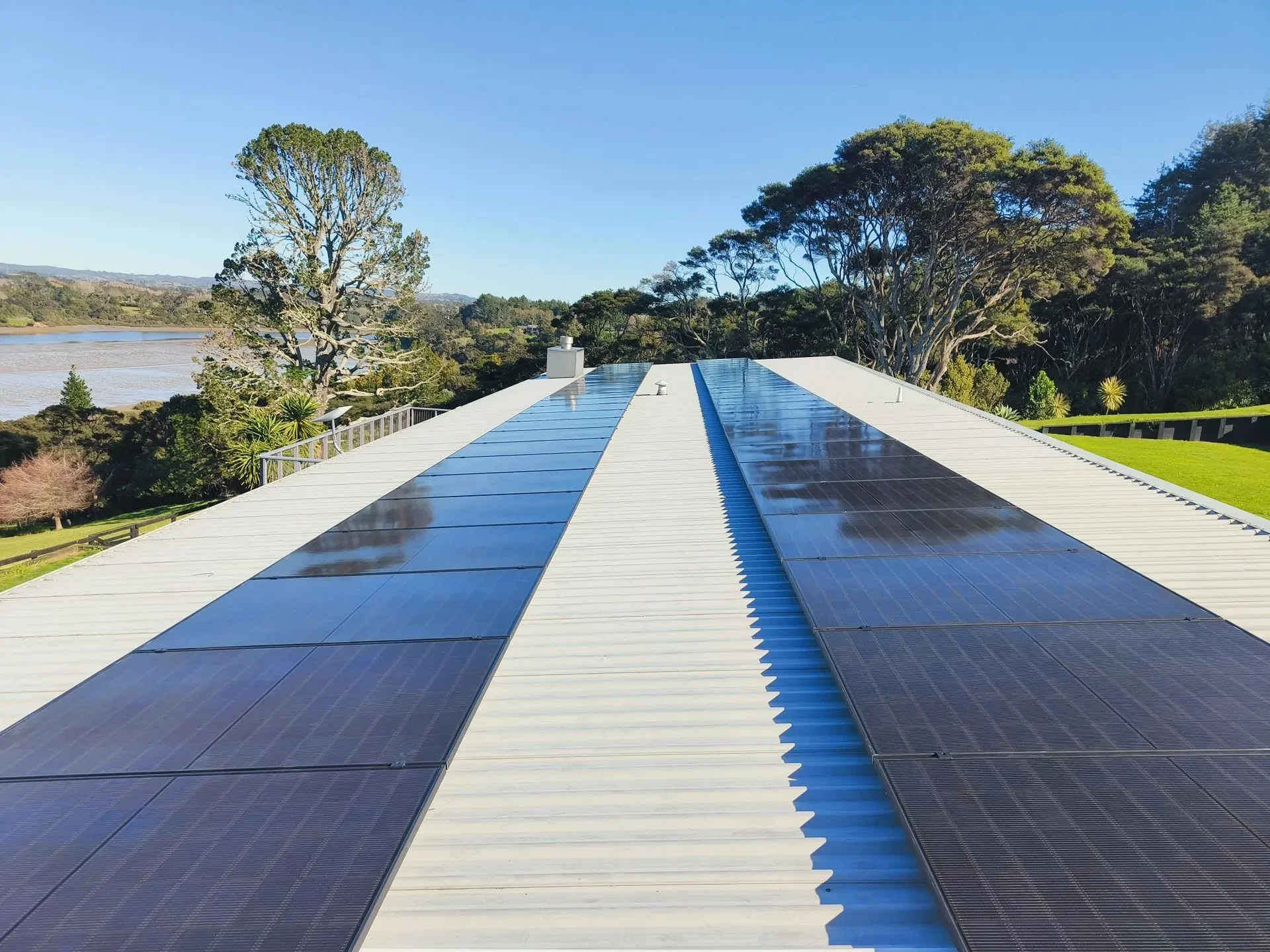
Three-Phase Solar Systems: Getting the Balance (and the Juice) Right
So, you’ve got three-phase power — lucky you. More headroom, smoother loads, and the potential for serious solar performance.
But here’s the catch: it’s darn complicated and a setup that looks good on paper can still fall flat in the real world — especially if it’s sized without thinking about startup currents, efficiency curves, battery discharge rates, or the quirks of your local grid.
Let’s fix that.
This isn’t about whether you should go three-phase (we covered that here and here). This one’s about how to make your three-phase solar system actually perform — so your inverter stays efficient, your batteries stay calm, and your house runs smoothly with a (hopefully) juicy three phase system.
City Homes: The Sweet Spot — 5kW Per Phase
If you’re in a metro area with stable grid power and no chunky loads like pumps or septic systems, you might get away with a 10kW three phase inverter and still experience a decent solar-backup experience. However - if you want to keep the 'nice to haves' working in a power cut, a 10kW inverter isn't going to cut the mustard, because they can only deliver 3.3kW per phase.
Power cut or not, 10kW three phase solar inverters generally leave money on the table - because 3.3kW deliver per phase is puny. Often times homes pull more on a single phase, which places demand on the grid (which you pay for); while the battery withholds energy until someone turns an appliance on down the other end of the house.
If you like the thought of heating your hot water cylinder in a power cut, read on....
If three phase solar systems can only output one third of their capacity per phase, a 15kW three-phase inverter (5kW per phase) is our strong recommendation for city homes. 15kW inverters deliver maximum savings and a great power cut experience.
That setup gives you heaps of flexibility — you can run a heat pump, and the jug all one one phase without stressing your inverter or triggering imbalance issues.
Simple, reliable, and efficient.
Rural Properties: Give It Some Muscle
15kW inverters are fine if saving money is the only objective, and you're happy to tactfully ramp down your homes energy use to stay within the guard rails.
Out in the country things get a bit more serious. Pumps, bores, and septic systems can create short, heavy startup currents that smaller inverters sometimes struggle to deliver without a hand up from the grid.
If that sounds like your property, go for a 20kW - 30kW inverter. The extra grunt will ensure your system won’t blink when the fam bam is home and living their best life.
You'll need to make sure your system designer considers the inverters start-up voltage and efficiency curves, though.
Strong recommendation: If you get an inverter larger than your solar array, say - 12kW of panels on a 25kW inverter - those panels should be facing the same direction, otherwise you are likely to have an inefficient system.
*By inefficient, we're talking 'efficiency' in its intended meaning.
*A poorly designed system can mean the 50kWh of energy from your solar panels may only result in 40kWh of usable energy.
Due to huge cost reductions on both panels and batteries, you can have a three phase system that keeps the place running effortlessly in a lengthy power cut for less than $50,000! The annual savings are likely to be around one tenth of the system price, so the ROI is generally over 10%.
Discharge rates matter: Make sure you have enough juice
Solar inverters can only output what is being input. A great power cut experience demands batteries that can 'push' enough energy through the inverter.
In the battery world, the C rating is how we define a batteries output. It's often talked about in the EV space.
A 1C battery can charge and discharge its capacity in the hour.
Some batteries have different C rates for charge and discharge (Tesla PowerWall 3 and many more).
Examples:
👉The current BYD Atto 3 has a 1C charge rate, which means it can fully charge in about an hour at those public chargers.
😘The new BYD Atto 3, coming late 2026, has a 3C charge rate, so it can fully charge in as little as 20 minutes. Unlikely in NZ, as our chargers fall short...
SigEnergy batteries are rated at 0.5C, meaning they can output half their stored energy per hour. So, a 20kWh battery can continuously deliver about 10kW of power. If your home demands more than that for more than few seconds (say, a bore pump or multiple appliances at once), the inverter will momentarily shut down and restart. Not much fun.
The solution for a 25kW three phase SigEnergy inverter? ... Buy 20kWh or 30kWh of batteries to be sure everything operates without a hitch.
Downside: That's a good 15 to 25k on batteries alone.
By contrast, many of the latest batteries from Sungrow, Alpha, Pylontech, Dyness, SolaX and more, are rated higher than 0.5C, meaning they can output more when demand requires. That gives you more “juice” for the same size pack. (Juice as in - when you squeeze them, lots of juice comes out). 🤑
Consider this. Instead of spending $20,000 on 30kWh of 0.5C batteries, you spend $8,000 on 15kWh of 1C batteries. You've saved yourself 12 grand and both systems are just as 'Juicy'. You squeeze both and despite the size difference, the same amount of juice comes out.
Take one of our clients in Canterbury. They installed an Alpha system with 20kWh of batteries. Basically cents on the dollar compared to the expensive brands, and able to output a solid 20kW consistent into his 20kW Alpha inverter!
No bad blood here, and certainly no favouritism – just the facts that conveniently get left out when clients are asking "do I really have to spend $40 or $50K?"
That said, we've singled out SigEnergy and run a huge risk here - so let us say this - apart from its discharge rating, SigEnergy leads the pack in almost every other area — such as:
Its mobile app is beautiful and its curation of data around energy flows is absolutely on another level
They offer individual battery cell temperature monitoring, which guarantees a level of safety no other system can offer.
Incredibly smart relay controls for diverting energy to less crucial loads, such as a your hot water cylinder.
Generator input for guaranteed resilience.
True whole home backup through the gateway.
DC-to-DC EV charging.
Vehicle to grid functionality
AI that really works, and more. Gosh – why wouldn’t you?
SigEnergy is incredible, that's the truth. But if saving $10,000 is important to you, the intention of this section is to highlight the array of great options on the market offering raw power for less. And don't go discounting those brands based on our limited comments, they all come with unique benefits!
It’s your money. And you have to decide.
The conversation is very similar to the one you've probably had around your choice of smart phone. Do you use Samsung or iPhone, and why?
Solar Array Sizing: Don’t Starve the Inverter
Now, let’s talk about the panels feeding all that hardware.
At a bare minimum, a 25kW inverter paired with a 13–15kW solar array will perform well if your panels face north and are pitched over 10°. That’ll give strong mid-day generation and consistent inverter operation.
But if your roof layout is split east-west or north-east / north-west, your production curve flattens. That’s great for steady generation across the day — but it means your inverter will operate at lower efficiency in the early morning and late afternoon unless your array is upsized to 18–22kW. Even more is better.
The goal is to keep your inverter supplied with enough DC input to operate in its sweet spot throughout the day.
There’s also another conundrum at play, which is – most of the DC current off your panels wont ‘spin up’ the inverter if the home isn’t demanding it. In periods of low-demand, the DC off your panels goes straight into the batteries. The impact here is - if your 25kW inverter is only running a fridge and your wi-fi modem, it may be operating quiet inefficiently. However, the losses are basically a rounding error at that point, because if you lose 10% of 1kW, who cares.
In short: don’t starve the inverter. A big one needs a proper breakfast.
When a Single-Phase System Makes Sense (and When It Doesn’t)
We have a blog on Why single phase might be your best three phase option. You only want to consider single phase if you’re not keen on spending more than $35,000 on your solar + battery system.
But if you’re happy spending $40–45k and going all-in, skip this section — you’re a three-phase candidate.
But just in case you're here and $35,000 + is out of the picture, even if your home is wired for three-phase, sometimes a single-phase solar system can make more sense — particularly if your incoming supply is rated at 63 amps per phase.
Why? Because 63A on one phase is enough to comfortably power an entire modern home. If you’re using less than 1,500kWh in a winter month and don’t have quirky high-load gear (like bore pumps, welders, or big spas), then you might actually save a chunk of cash by keeping it simple.
In that case, a 10kW single-phase system with a decent battery could deliver the same real-world savings and backup performance as an underpowered 25kW three-phase setup — for $5,000 to $20,000 less.
In other words, a well-sized, well-optimised single-phase system will often outperform a “big” three-phase inverter paired with too few panels or too little battery. That’s not the rule — but the point is, don't discount single phase solar on the basis of having a three phase home.
However… this logic only holds if that 63A supply is real and consistent. Sometimes the simplest indication of a real and consistent 63A supply is to observe how many neighbours you have.
No Neighbours for miles - 63A constant and reliable delivery per phase is unlikely.
20+ neighbours within a 2 or 3km radius - 63A continuous delivery per phase is quite likely. If it wasn't, your neighbours would be out with their pitch forks 😂
But for those in the deep country and with inconsistent 3-phase power, you can forget the single phase idea entirely. Because if you shifted all your appliances to single phase - you’d likely be relying on only 7kW total delivery (32 amps) to run your home. Not ideal during a rainy week. You'd be lucky to survive a winter night after your batteries discharge. Your best bet for energy security is keeping three phase supply and getting three phase solar.
The Real-World Takeaway
Here’s the cheat sheet:
City homes: 15kW inverter (5kW per phase) — perfect balance.
Rural homes with pumps or septic: 20–30kW inverter, and enough battery power to back it up.
Panel sizing on the 25kW inverter: A bare minimum solar array size of 13–15kW for all north-facing panels; and 18–22kW for east/west or something in between.
Single-phase setups: Great option if you're keen to save some coin, genuinely have 63A per phase and are a low to medium power user. However, very risky if your local grid can’t sustain your home when your system runs out of juice. Your sparky (or winning solar company) can confirm this by testing the voltage of each phase at peak times, ideally in winter.
Getting three-phase solar right isn’t about throwing more hardware at the wall — it’s about balancing inverter power, battery discharge, and solar array size to match your properties reality.
When that balance is right, your solar system hums — smooth, stable, and efficient, no matter what the day throws at it.