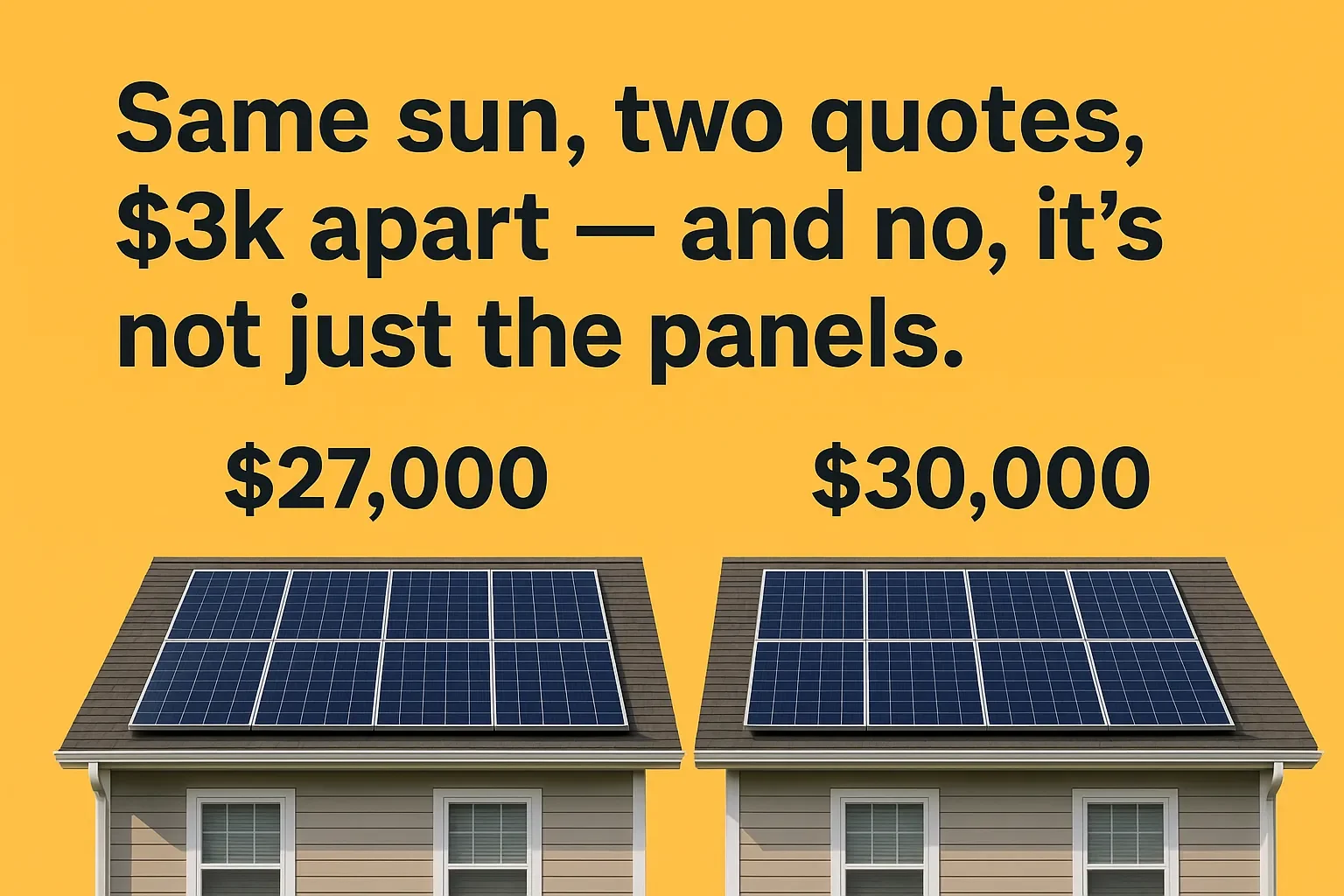
Ever looked at two solar quotes and thought, Why on earth is one $3,000 more than the other when they both promise sunshine on my roof?
Here’s the short answer: it’s the gear.
Here’s the longer answer: well… gear is just the start.
The Gear Gap
Solar quotes aren’t built equal. One installer might spec panels that cost them $100 each. Another might go for a premium panel costing twice that. Same goes for inverters and batteries.
The irony? The extra cost rarely buys you more features. These days, the bigger price tag usually boils down to:
Reliability – The pricier product might have only 1 in 100 units fail under warranty. The cheaper one? Maybe 1 in 50.
Customer Support – When something does go wrong, the higher-end brand might actually answer their phone.
Looks – Yes, some buyers will happily pay more just because it looks sleeker on the garage wall.
Brand Perception – Marketing magic. A bit like wine labels — the same grapes taste better if the bottle looks fancy.
Why Solar Companies Care More About Failure Rates Than You Do
Installers hate going back to fix things. It costs them money, pulls their crew off profitable jobs, and generally ruins their week.
That’s why they gravitate toward gear that has near-zero call-backs.
But here’s the kicker: if you buy the less popular brands, something with a “1 in 50 chance” of failure, you’ve still got a 98% chance of smooth sailing.
So when you’re staring at a $30,000 quote for the Rolls-Royce inverter and battery versus $27,000 for the Toyota Corolla version… the smart question isn’t “which is better?” — it’s the same question we ask with every purchase - “What am I paying, and what am I getting?”
Because in todays market… $30,000 might get you 20 premium panels and a premium 10kWh battery.
Or it can get you 20 panels and 15kWh battery from a ‘mid-range brand’.
And so, you might also need to ask - “Should I risk being the 1 in 50, to get a 50% larger battery?”
It’s Not Just the Gear – It’s the Margin Game
This is the bit no glossy brochure will tell you.
Some solar companies run higher profit margins on every job, regardless of the gear. Others keep margins lean because they know the equipment is reliable and service calls will be minimal. Then there’s the third margin category…
High margin on cheaper gear – Yes, it happens. You could be paying a high price for ‘cheap’ equipment, because the solar companies are more likely to come back to replace it.
Lower margin on premium gear – Some solar companies are happy making less money on premium gear, because it causes them less issues.
The “overhead tax” – Higher prices don’t always mean a greedy company. Some companies just have huge overheads: slow employees, expensive vans, poor supply agreements and equipment prices.
It’s easy to think a quote is “overpriced” when you’re really just paying for someone’s business model. No company is the same.
Sometimes Cheaper Gear Makes Sense
Here’s something that surprises a lot of people — sometimes, going for the “cheaper” inverter or battery is actually smart.
Why? Because the company behind it might be a big, stable player who’ll still be here in 10 years and will actually send someone out to fix it if it fails. Many larger installers are brilliant at supporting their gear, even if it’s not the most premium on the market.
And cheap doesn’t mean “bad.” Take SolaX and Goodwe. On most of their residential inverters, the start-up voltage is just 40–50 volts. Compare that to some “high-quality” European brands that don’t fire up until the panels are pushing 80 volts. If all your panels face one direction, that’s fine. But if you’ve got 4–6 panels catching sunrise or sunset, that lower start-up voltage could mean you get an extra 30 minutes of production each day.
Yup, some brands cost less. That doesn’t mean they aren’t worth your attention.
Global Warranty Support – The Gold Standard
Some brands offer global warranty support that’s hard to beat. Enphase, Tesla, SunPower — they don’t just cover the replacement part; they pay for:
The labour to diagnose the issue.
The freight to send the faulty unit back.
The labour to install the replacement.
Even the cost of disposing of the dead one.
If you value hassle-free ownership, this is a huge plus.
When 460W Panels Aren’t Created Equal
Ever noticed how every panel these days seems to be “around” 460W? Here’s the secret: the wattage number on the sticker doesn’t mean much in the real world.
The difference between a $150 panel and a $250 panel of the same wattage can be huge. On a perfect sunny day, the cheaper one might crank out 3kWh. The pricier one? More like 3.5kWh.
Why? Because there’s a whole cocktail of factors at play — temperature coefficient, voltage open circuit (VOC), bifaciality, N-Type vs. P-Type cells.
If you don’t want to spend 40 hours on Reddit or watch a guy in the Middle East poke panels with a voltage meter, the alternative is simple: buy from the most trusted brands in the industry. We’ll steer you toward them.
The Word on the Street (And Why It’s Sometimes Wrong)
In solar, reputations stick — even when they shouldn’t.
Take SolaX. They were one of the first to launch hybrid inverters and crack the nut on three-phase load balancing. Pioneers. But pioneering means teething issues, and in our industry, being first can get you dragged through the mud. Some installers wrote them off years ago and never looked back — even though the gear is now solid.
It’s the same story with Alpha and Pylontech. They’ve got strong offerings today, but for some, old perceptions die hard.
And yet… along comes SigEnergy, a brand-new player, and the industry embraces them with open arms. Go figure. Sometimes “word on the street” is just selective memory mixed with shiny-new bias.
How We Play Detective
Think of us like CSI for solar quotes — minus the sunglasses and crime scenes. We get under the hood of each proposal, working out:
Is the equipment spec pushing the price up for the right reasons?
Is the margin reasonable, or are you paying for someone’s fleet of luxury vans?
Is “word on the street” actually relevant in 2026, or is it leftover industry gossip from 2018?
We do the digging so you don’t have to — because the right choice for you might be the “Corolla” with an extended warranty, or it might be the “Rolls” because you never want to hear the word “fault” in your life.
The Broker Advantage
We’re not here to crown a single brand as the best. We’re here to uncover the why behind the quote, so you can make an informed call.
Because the “right” solar gear isn’t always the most expensive. It’s the one that fits your budget, your risk tolerance, and your home’s needs — and that’s something no flashy marketing or single brand loyalty can give you.
And yes — we’ll tell you the stuff your installer probably won’t.