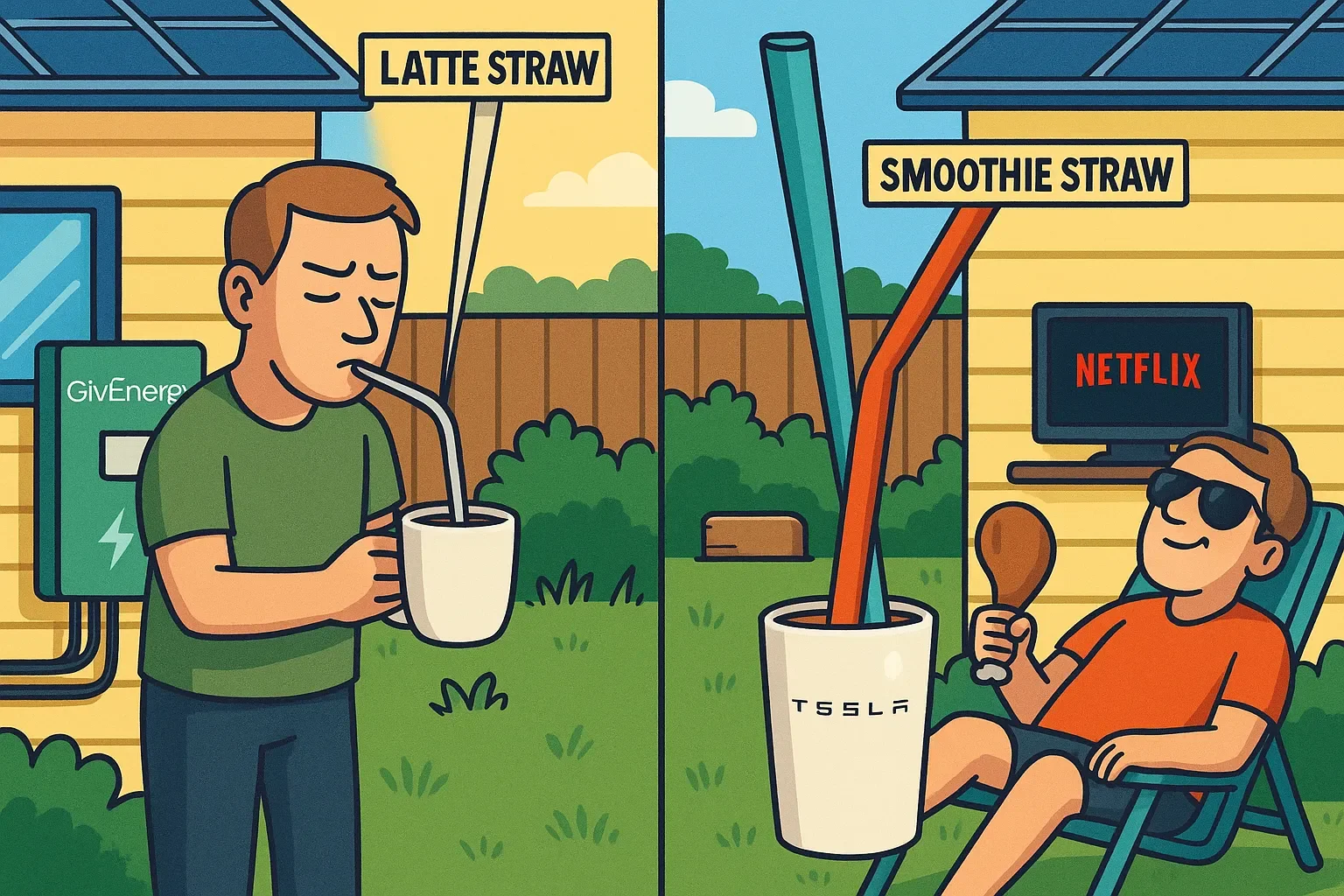
Lil' Ol' Jimmy has a lot to learn about solar batteries
🔋 Buying a Solar Battery System in NZ? Here's What the Solar Bros Won’t Tell You
Going solar, huh? When it comes to batteries, the real power is in the details.
This article is your no-fluff guide to getting a battery system that actually performs — in Auckland storms, Waikato brownouts, or Christchurch's cheeky pre-Christmas roast.
☀️ Plan Ahead or Pay Later
If you're installing a hybrid inverter today with dreams of adding a battery “sometime later,” make sure “later” doesn’t mean five years from now. Why? Batteries and their compatibility with other brands move fast. By the time you’re ready, your hybrid inverter might be as useful as a fax machine at a Zoom meeting.
Golden rule: add the battery within 1–2 years max. If you wait too long, you might not be able to find compatible battery modules without replacing the inverter too. That’s not futureproof — that’s expensive.
If batteries don't currently make sense for your wallet or home, don't get a hybrid inverter for the 'maybe' battery in 5 years.
📦 Battery Capacity Isn’t Just a Number
Let’s say you’ve got a 10kWh battery. Does that mean you can use 10kWh? Nope. Most batteries hold a little back to preserve their lifespan. Some let you use 9.5kWh, others only 8kWh. That difference adds up over 10+ years.
Also — some brands quote total capacity, others quote usable. Always double check.
⚡ Inverter Output: The Power Bottleneck
This is the cap on how much power your system can actually push into your house at any one time.
A 5kW hybrid inverter can only output 5kW continuously, no matter how big the battery is. Think of the inverter like a coffee straw — you can have a swimming pool full of latte (battery capacity & output rating), but if your straw is tiny (inverter limit), you’re not sipping fast.
This is where brands like Sungrow, Tesla, Solax and Pylontech shine — their inverters push out more juice, faster.
🔌 Battery Output: Don't Get Caught with a Shallow Pool
Not all batteries are created equal. Some can keep up with your appliances — others collapse when you turn on the jug.
Let’s talk about a real example from the Waikato. One homeowner recently bought a battery setup from ‘NZ’s most trusted solar installer’. They bought a 3-stack GivEnergy battery, which is advertised as the #1 battery in the UK.
On paper? 10kWh. Sounds alright. But the shock came when they learned it can only output 3.6kW continuously. That’s 230v at 16A. Translation? In their first power cut, they had two power cuts. The grid went down, and then the inverter and battery went down. Not ideal.
Seems crazy because there’s another battery out there called the Alpha. Alpha was Australia’s most sold battery in 2024. It’s cheap as chips compared to almost everything else. Their 8kW inverter + battery combo can do 8kW continuous, and 12kW for 30 seconds!
Most batteries on the market easily push out 5kW, but not all. 5kW continuous is enough so you can turn on your jug, while your Wi-fi, lights, and a cheeky heat pump keep on keeping on without a huckup.
We’re all for less capable options in the market place. But call (and price) it for what it is. If your solar battery can’t power an air-fryer, what's the point of living?
2026 hindsight: The comments above were written in 2025. But since then, GivEnergy has filed for liquidation.
⚙️ Switchover Time: When the Grid Goes Down, How Fast Do You Bounce Back?
This one’s a biggie. When the grid cuts out, how quickly does your battery jump into action?
Sigenergy: 0ms. You won’t even notice the lights flicker. Mint price too.
Tesla Powerwall: About 1ms. Still seamless.
Sungrow: Basically the same as Tesla.
Deye: under 4ms
Pylontech Force: Under 10ms
GivEnergy: Up to 10 seconds. That’s long enough to trip devices and maybe even your Netflix download.
Solis: Same as GivEnergy, but for about half the price! (The battery options on the market with Solis are great value too!! The Dyness Powerbox pro is a great performer.)
Alpha: Up to 20 seconds, but not to worry – it’s a fugg’n good price and you can't expect everything you want in a cheaper alternative.
Tauranga story time:
A bloke down down the road installed the latest Tesla Powerwall. His house kept ticking along just fine when a boy-racer struck a power pole with his lox-lux ute. Even though the Tesla Powerwall owner was roasting chicken, he didn’t even turn off the oven - because it was still sunny and he knew the 10kW output from his battery was more than enough to carry on! These are the real, tangible benefits of batteries with fast discharge rates.
🤖 AI Charging? Kinda Nice, Not Entirely Necessary
There’s a lot of hype about AI integration and how it will make money for you while you sleep.
But we think the extra pennies might not be worth the damage to your battery.
Remember Solar Zero? Part of their business was making money off energy trading. But as they folded - maybe they found the numbers didn't stack up as well as they hoped?
Most modern batteries let you set a charge/discharge schedule. That’s where the real win is in NZ. For example:
9PM–7AM: power is cheap — discharge to 5am until its empty, then charge from 5am to 7am.
7AM–11AM: expensive — battery discharges.
11AM–5PM: solar kicks in — battery chills and charges.
5PM–9PM: everyone’s home, power’s pricey — battery discharges again
Set that up once. Update it if your power plan changes. Done.
🔍 Final Word: Don’t Fall for the Flashy Brochures
There’s a lot of noise out there. But when the power cuts and your kids are forced to choose between the PS5 and playing outside, you’ll know if you chose the right system.
So don’t just look at battery size. Look at:
Continuous power output
Switchover time
Inverter size. This one gets missed often.
Forget it – our mission is to simplify the entire process. Leave us your deets and you won’t have to worry about any of this complex jargon.
Solar isn't like a one-size-fits all flexi fit cap. Use our service and get the ideal solar system for the ideal price.
This blog reflects our ultra-professional and super biased opinions based on actual market feedback, real world data sheets, tons of recent chinwags with over 30 solar companies, real-world performance, and what we’ve seen on rooftops from Auckland to Christchurch. All product data is accurate to the best of our knowledge at the time of writing. We’re not here to throw shade — we’re here to shine a light.
Any references to other solar companies or products are general in nature and based on publicly available information. We don’t claim affiliation or endorsement, and we always recommend you double-check specs and consult with a qualified sparky before making a decision. Equity Solar Brokers is not a solar installer — we’re your independent solar matchmaker. And yes, we read the fine print so you don’t have to.