Is it worth oversizing your solar inverter?
More DC power is a good thing (to a point) 👌
Let’s clear something up right out of the gate: oversizing your solar inverter is not a sin. In fact, it’s smart—especially because in most cases, solar panels different directions and generate their peak energy at different times of the day.
You're probably thinking: “If I get a 6kW inverter, are you telling me to get 8kW of panels?”
Heck yes we are! Welcome to the wonderful world of intentional oversizing.
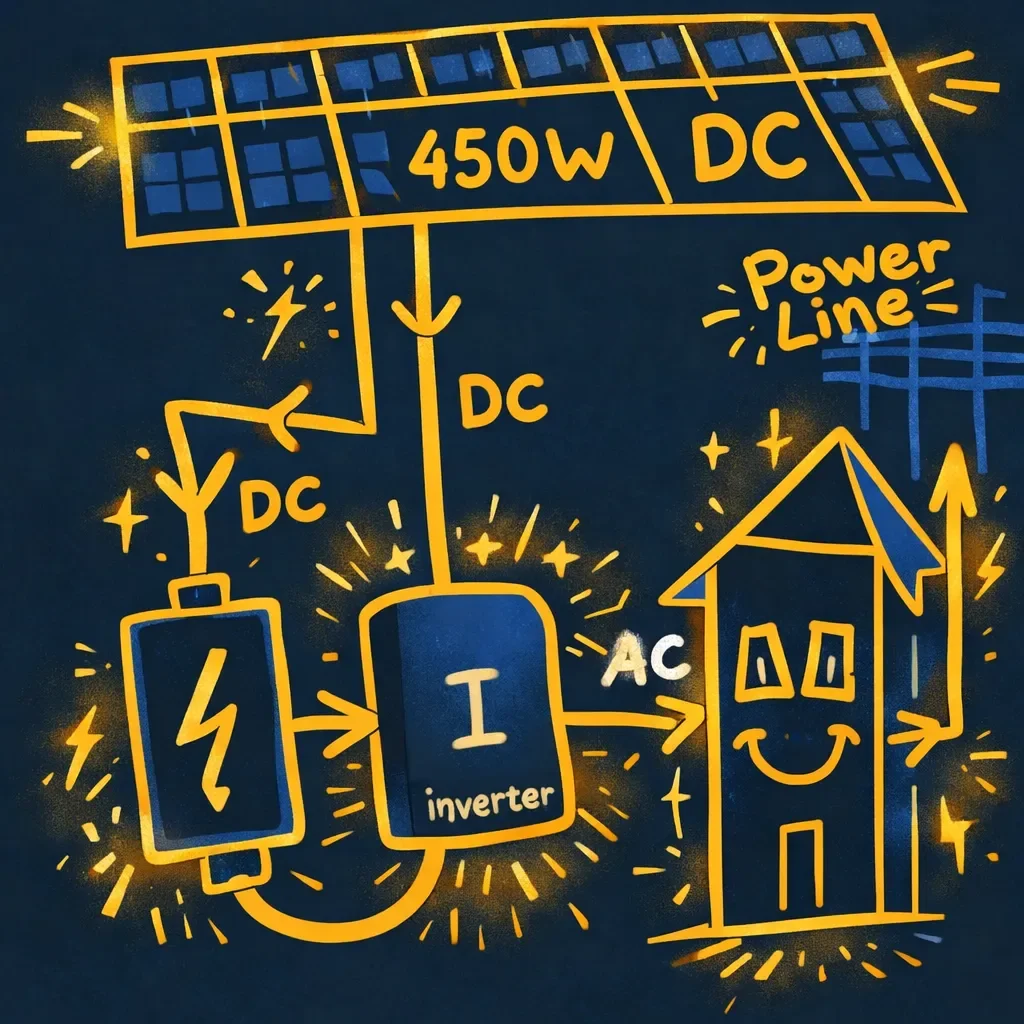
As per the image, the simple explanation is - solar panels produce DC current, which gets turned into AC when your home needs it, or when you are selling it to the grid. Energy going into the battery ISN'T converted to AC until you use it in the evenings.
So, oversizing your panel array is an absolute no brainer with a battery. But even without one, it still makes sense - to a point.
What Is DC Oversizing?
Oversizing simply means installing more solar panel capacity (kWp) than your inverter’s rated output. So if you’ve got a 6kW inverter and you install 8kW worth of panels, that’s a 33% oversize.
Some folks get nervous about this. “Won’t I be losing out all the time?”
Sure - you'll lose out a little bit, but only on the sunniest days, in the sunniest months. But you won't lose a penny in winter.
Reality is, unless your panels are all facing the same direction, and pitched north, your panels are unlikely to hit their rated output in the shoulder and winter months.
In summer time, yup - you might suffer from 'clipping' ; where DC can't be converted into AC due to a mismatch between generation and inverter size - however - none of our clients really care about their generation in summer. Because in summer, they have way too much solar.
We’re not living in a lab. Half the time its cloudy and that means your panels under perform.
70% of the time its not 'lunch time'; but instead its 10am, or 4pm, etc... So; your DC oversize is actually a match made in heaven.
But even with a huge over size, nothings going to blow up. This is generally true even if you had 9.9kW of panels on a 5kW inverter.
Why? Because solar inverters take what they can and need. They're not under oath to take any more. The spare energy just stays in the panels - which isn't a problem in most cases. Read more below on the downsides of such an oversize.
The electrons that get 'clipped' just take another lap around the solar circuit.
Here’s Why 30% Oversizing Makes Sense
Outside of the sunniest summer days, you need all the panels you can get.
Nobody regrets getting more panels. And a few more panels is cheap. Adding 5 more panels to a any system costs very little, and the benefits are huge - even with a small amount of clipping on the sunniest days.Inverters operate more efficiently with more DC. An oversized panel array means that on a cloudy day, the inverter still has lots of DC energy to play with. This generally means a higher DC to AC conversion efficiency. (Yes - inverters battle efficiency, just like batteries do)!
You have a DC coupled battery
There won't be any clipping if unconverted energy goes straight into the battery. This is the common solution these days!🔥With 8kW DC - 4kW may go to the home as AC current (if it needs it), and the other 4kW DC goes straight into the battery. Very cool.Your panels face different directions.
Just because you have an 8kW system, you're never guaranteed a full 8kW of DC current from the panels. Especially if your panels face different directions!
The Kiwi Context: 10kW Inverter, 13kW of Panels = Sweet Spot
New Zealand’s single-phase homes tend to be limited to 10kW per hour of export, unless you're unlucky. (Just wellington at this stage.)
Auckland is going 10kW in July 2026. Tauranga, Palmy, Canterbury, most areas have the 10kW export limit.
A 13kW system is about 28 panels. You can have that installed for about 23k without a battery, maybe a little more or less.
... Worst case scenario ... If you sold all of it to the grid for 17c, you'd get paid $2,800 per year from your retailer. That's a 12% ROI, and an 8 year payback period!
If you have 2 or three phase, double or triple that 10kW export limit.
*Some regions have limits based on the capacity of the 'neighbourhood transformer'. There's a few suburbs in Nelson that are at max capacity. Expect more to hit capacity as solar ramps. Best you get in quick!
In Wellington, and other unlucky regions with the 5kW export limit, pairing ~10kW of panels on an 8kW inverter means you:
Generate tons of energy, even on the cloudy days, keeping your inverter in its most efficient zone
Don't lose much energy to AC Clipping, because spare energy goes straight into the battery without being converted to AC! (Google DC Coupling).
Time some loads for the mid-day, to soak up some of the energy generated that exceeds the 5kW export limit. Hot water cylinders are a great one, but spa pools, air conditioning, pool pumps, septic & bores, all work a treat.
Might lose 3 - 10% of your energy, if the system is designed poorly. All the more reason to use a Solar Broker.
But why so large?
We aren't recommending a 13kW system as the ideal for kiwi homes. But we are making a clear point - and that is - you can go large, and there's practically no limits now! Its exciting times.
The 13 / 10 analogy is simple to understand, and to explain. The rule also covers:
👉11kW of panels on an 8kW inverter
😘 8kW of panels on a 6kW inverter
👌6.6kW of panels on a 5kW inverter
And what are the actual benefits... ?
Over sizing your inverter is strategic, because it means you get a larger system for a small cost increase.
Adding panels is cheap, but increasing your inverter size isn't.
If you're looking at a solar quote where the size of the array matches the inverter, and you want to add a few more panels, it's handy to know that you don't have to over invest in an inverter upgrade.
For example, an 8kW inverter costs about $2,500 more (installed) than a 6kW inverter. This is mostly accurate for the favored brands like Sungrow, SigEnergy, and Fronius.
Spending $2,500 on five more panels sounds easy, but spending $5,000 on those panels plus an inverter upgrade may add another year to the system payback.
Larger inverters have their merits, but in terms of savings; they don't always make the most economic sense.
When it definitely doesn't make sense
We see quotes from all kinds of companies. It's part of our service to provide unbiased feedback, and if we can - we help our clients get a better deal.
We often see quotes from a company that rhymes with 'Solar-Chub' ; which often includes around 22 panels on a 5kW inverter.
That's 9.9kW of DC current... Which, is definitely over kill.
A system with a 90% oversize doesn't work very well and probably won't last very long unless the panels are split east west.
In most cases a 90% oversize would result in immense clipping, a tired solar inverter, and faster degradation of the panels due to the heat generated by immense amounts of trapped energy.
👉99% of the time, we wouldn't recommend any more than a 150% DC oversize. The only exception is when the panels are on a steep roof, and split east west.
IE; one of our clients has panels on a 40 degree pitch, east west.
😎They have 11kW of panels on a 6kW inverter, and it works a treat. It's basically TWO independent 5.5kW systems, but they share the same inverter!
🔥We didn't opt for the 8 or 10kW inverter as the larger inverters have different efficiency curves, and in the middle of winter, the 6kW inverter would actually perform more efficiently.
The Final Word
If your solar installer tells you 33% oversizing is bad—they’re probably stuck in 2015.
And if they tell you a 10kW inverter on single phase is overkill, don't be afraid to ask why.
The modern reality is this: panels are cheap, inverters are smart, and oversizing is strategic, not catastrophic.
So go ahead. Be a little oversized. Because when it comes to solar, bigger (within reason) is usually better.