Ah, the golden question. “How many panels do I need?” It’s usually the first thing people ask, and the truth is: there’s no one-size-fits-all answer. But there is a simple rule of thumb you can use to size your system smartly — without ending up with too few panels (pointless) or too many (wasted).
Let’s break it down.
The bare minimum “Half Home” Rule
Most Kiwis plan to get a battery now, or later. If you’re in that camp - then the absolute smallest solar system you need should:
👉 Cover half of your winter energy demands.
Why half? Because in a power cut, half the house is all you really need: the lights, Wi-Fi, fridge, freezer, and a bit extra on a sunny day. That’s your survival kit.
Whether you get a battery or not, this is still the smallest system you need.
In most cases, we start our solar design using this framework. We may work our way up while swinging within the guard rails of export limits and your homes actual summer usage.
But actually, getting a system that generates closer to 75% of your winter usage is the better bet.
Because, lets say you generate 75% of your winter usage. Does that automatically mean you get 75% off your power bills?
No way! Why?
Because your power bills are made of the power you’ve used, AND the daily fixed charges.
If you generate 75% of your winter energy demand, you might only see a 50% bill reduction.
So… Why go any smaller… if you do, it just means you’ll cringe at your winter power bills.
Do all the panels now.
Some of the worst advice in the solar industry is “get an upgradeable system. Start small, and add to it later.”
That’s absolutely dogshit advice. Why?
Because the cheapest way to get panels is to get them all at once. IE:
👉20 panels now costs about $20,000 installed with a decent solar inverter.
🫨10 panels now costs about $14,000 installed with the same ‘decent’ and ‘future proofed’ solar inverter.
😅Expect to pay another $10,000 for the extra 10 panels later.
… Splitting up your system into two installs basically adds 20% to the cost.
Why? Because small jobs still carry the same ‘overhead costs’. You’re also paying twice for the callout, harnessing, lunch breaks, access, scaffolding (if required), travel, and the list goes on.
If you want to do solar in stages - the best approach is to get all the panels you need now, then add the battery later. This approach creates less unnecessary spend, due to the simplicity of it.
But FYI… ‘Future Proofing’ your solar inverter could be a grave mistake.
Sizing by sun hours
Solar geeks like us talk in “sun hours.” It’s all a bit confusing, because one sun hour isn’t the same as an actual hour in time. It’s just a metric — and represents one solid hour of full summer sunshine.
In reality, one sun hour can take two or three real hours to “add up,” and depends on both the season and the weather.
Here’s what you can expect:
Winter: ~2.5 sun hours a day on a perfect north roof (but its better to design off 2 - to be conservative. Not many people have the ‘perfect’ roof).
Summer: ~5 sun hours a day, sometimes more.
Think of it like this: panels produce energy based on sun hours, not clock hours. The pitch & direction of your panels plays into how many sun hours your panels will enjoy.
Wondering about the best panel direction?
Quick Math: Sizing to Power Half the House
Here’s the simple formula we use:
Winter daily usage ÷ 2 (for half the house) ÷ 2 again (for 2 sun hours).
Example:
A household uses 30kWh on a winter day.
Half the house = 15kWh.
With 2 sun hours, you need a system that generates 15kWh ÷ 2 = 7.5kWsolar system required.
Buyback rates: The Invisible Ceiling
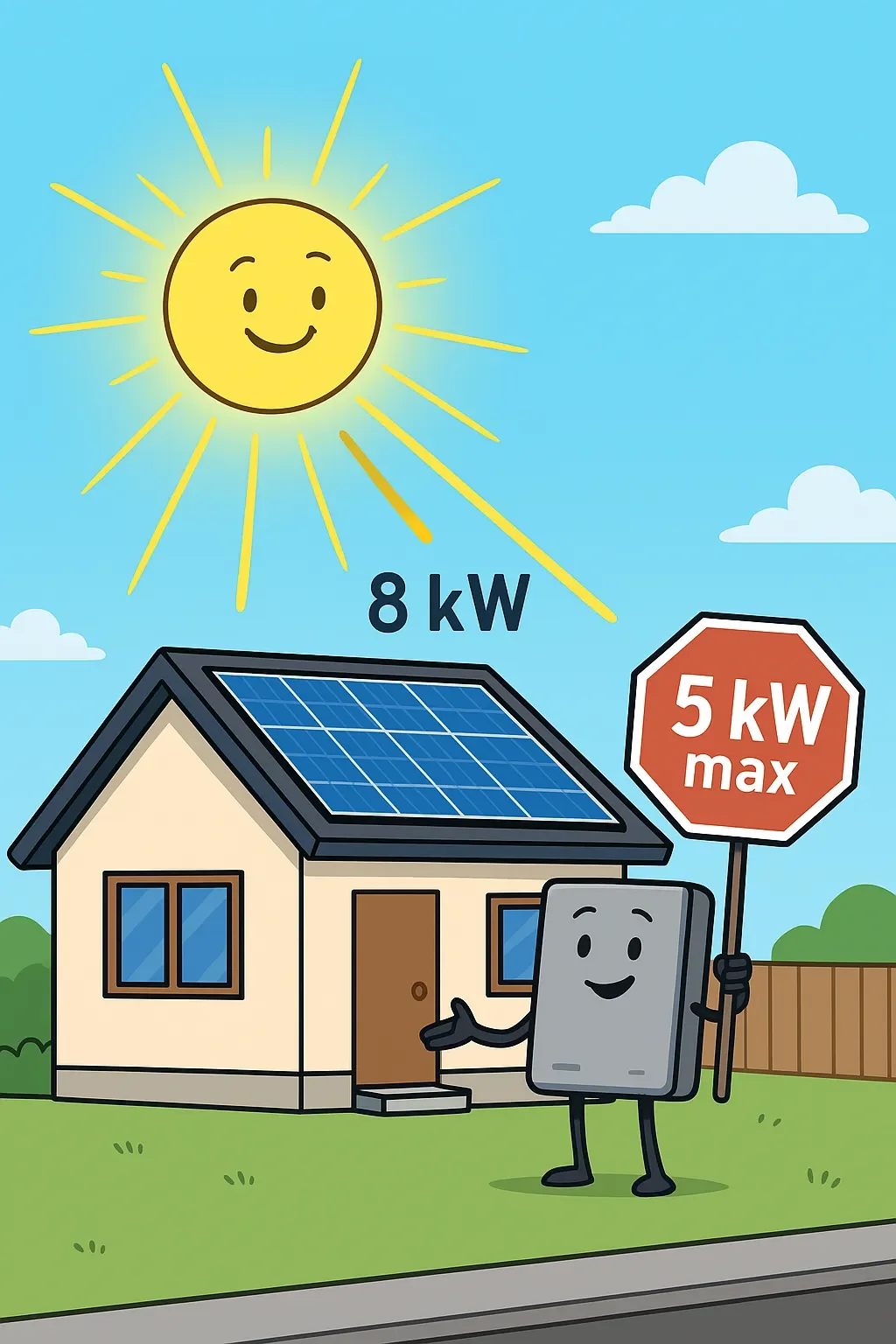
Here’s the bit most people don’t get until it’s too late - the best buyback rates are only available when the solar inverter is 10kW or less.
That’s it. Doesn’t matter how many panels you’ve got — the inverter is what the network looks at when deciding if you qualify for those super sharp buyback rates from the likes of Meridian and Octopus.
This something to keep in mind when sizing a system. Its why it often doesn’t make sense to install a system that covers 100% of winter usage. Because when you do that, you may end up with 5X the energy you need in summer, and a stink buyback rate to go with it.
PS: As at May 2026, Ecotricity and Electric Kiwi offer some great buyback rates for the larger solar systems!
So… How Many Panels?
… It depends. But the simple rules are:
Cover at least half the house in winter.
Size using 2 sun hours, not 5.
Check the terms of those buyback rates.
The Final Word
Solar isn’t about panel counts. It’s about smart design.
Too small, and you’ve wasted your money. Too big, and you’ve sold your power for pennies. But get it right — sized for winter resilience and summer efficiency — and you’ve got a system that keeps your lights on, your bills down, and your fridge humming even in a blackout.
FYI - This blog used to talk about the buyback limit of 5kW per phase. Now it doesn’t, as that’s practically a non issue. But for those in Wellington… You’re unluggy, and need to consider the 5kW per phase buyback limit.