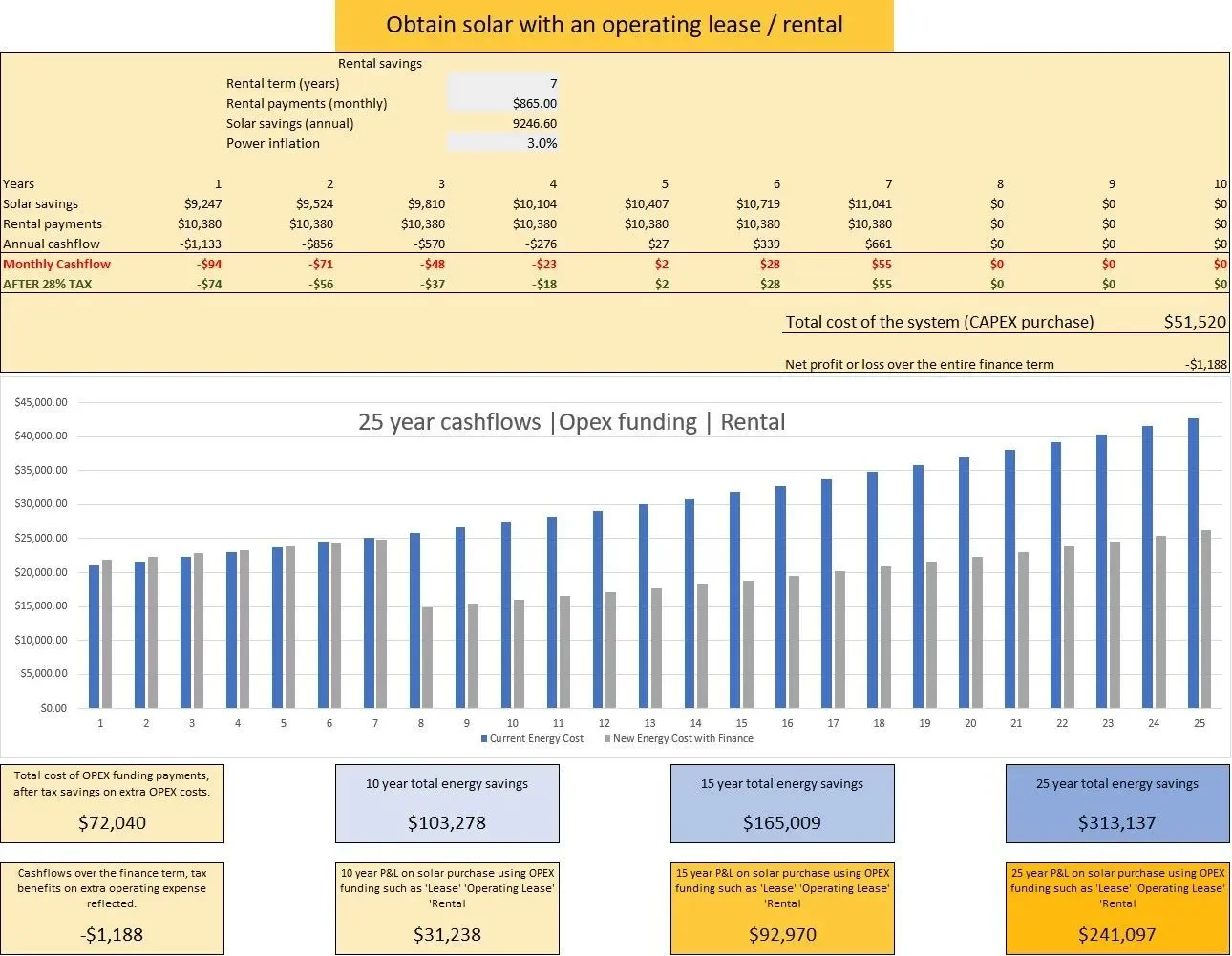
Here's a snip from a client we consulted with in 2024.
Sales pitch was...
"Spend $51,250 to get immediate benefits from solar. They’d own it, and save over $9,000 per year in energy savings. "
🤜OR🤛
- Get the system on their roof for $74 per month. (This is the net result of subtracting the savings from the lease-to-own repayments).
- With power prices increasing at 3% P.A, they’d start saving at year 5.
- On a 7 year Rental term, the extra OPEX costs incurred in the first 4 years are mostly paid for with energy savings in the final 3 years.
- The total cashflow over 7 years was a minor cost of $1,188.
- From year 8, they’ll start saving over $10,000 per year.
- Over 25 years, the system saves over $300,000 in energy costs.
- That’s a net profit of $241,097 over 25 years, based on an investment of $1,188.
… $1,188 is what the system actually cost them, because the first 5 years of solar savings covered most of the lease-to-own repayments.
👌They’re looking at a 20,294% return on their investment over the 25 year period. That’s manic. That’s Unheard of. That’s the power of using other peoples money to buy solar.
Here’s the down low on solar for New Zealand SME’s:
How does solar compare to other investment opportunities?
- Reduce your energy costs
- Add a sustainability angle to your brand, or increase the positive impact you’re already making
- Support NZ’s transition to 100% renewable energy, and more importantly
– Directly contribute to solving NZ’s critical energy supply challenges, often faced during the middle of the commercial day
Consider this. Take your average monthly energy bill and multiply it by 384.
The answer reflects how much your business will spend on energy over the next 25 years, and that’s assuming only 2% inflation. If those figures raises an eyebrow, consider our FREE commercial solar analysis to explore the immense value of an investment in solar for your business.
Equity Solar Broker’s simplify the entire process of procuring solar, from feasibility to comparing quotes. We help you navigate the complex funding options and get clear on the value of the investment.
With panels now lasting upwards of 25 years, the long-term financial benefits are expansive, not expensive. Within 15 years, most solar systems pay themselves back three times over. IE; spend $50k and save $150k in approximately 15 years.
Funding considerations
- CAPEX with cash and see immediate cost savings on your energy bills. Typically in commercial scenarios, solar systems pay for themselves in about 5 years, providing an ROI of 20%.
- CAPEX with external capital. The payback period will be increased marginally due to interest on the loan, but like some businesses you may view interest as a necessary cost of doing business. As the savings cover most or all of the repayments, it can be argued that your ‘investment’ is tiny. (We are cheekily defining your investment as the net cost of cashflows over the finance term).
- OPEX with a lease / rental facility, with ownership at the end of the term for the small residual value. We model the cashflows, handle the paperwork, and even obtain a credit decision without needing to see your financials. (*No financials required for systems valued under $150k).
- Get a free system, with guaranteed savings on day 1. We maintain relationships with a couple of providers who can own, operate, and maintain your solar system and guarantee immediate savings on your energy bill. You take ownership after 10 or 15 years.
Solar could be more profitable than other internal investments
All businesses make investments, often with the intention of growing their operations and ultimately their profitability. New machinery, products, and services, tend to provide an immediate source of revenue, but take time to achieve profitability. This comes down the overall efficiency, both in the new operation itself and the people and processes that spin the wheels. Profit feeds your next CAPEX investment, and so with every investment, your bottom line must be considered.
When will this new investment generate a profit, and how much will that profit be?
Solar provides savings on your energy bills, which could be compared to the revenue from your next investment. Undoubtedly, the solar-energy savings would be less than new revenues from new investments. But with very minimal operating & maintanance costs, most of the energy savings fall to the bottom line, and can therefore be likened to net profit.
How does a 20% profit compare to your next CAPEX opportunity?
Does Solar Take up space inside your facility? Incur day to day operational costs? Create waste or byproducts? Take sick days? Get taxed?
We believe solar may be a great investment for your business and would love to explore the idea with you Our Solar-Broker service is FREE and includes:
💁 Free Consultation
👷♂️ Expert System design
💵 Finance modelling
🗝️Quote procurement
🙌 Support in decision making