Breaking down the true costs, benefits, and backup potential of solar batteries.
Whether you’re a homeowner or a business owner, you’ve probably wondered:
- "Should I get a solar battery?"
- "Are solar batteries worth it?"
- "How much more will I save with a solar battery?"
In this guide, we’ll get into the savings and benefits of solar batteries. But first, let’s talk about something even more important: energy resilience.
Solar batteries and their impact on energy resilience
Without a solar battery, your solar system will not work when the grid goes down.
Yes, even those beautiful panels on your roof won’t do a thing.
Here’s why: New Zealand regulations require grid-tied solar systems to shut off during outages. This prevents power from flowing into the grid and potentially harming workers repairing the lines.
But solar batteries? They allow your system to keep running when the grid is down.
So, ask yourself: Do I need power resilience for my home, business, or family?
- If your answer is a resounding YES, great! We can help you by designing the ideal solar system that ticks all the right boxes, including price.
- If you’re unsure, keep reading—we’ll help you weigh the benefits.
How solar batteries enable partial or full home backup when the grid is down
Approximately 30% of NZ solar systems have batteries. And most of them keep things operational when the grid goes down, but not all.
Some solar batteries connect directly to the solar inverter. These systems are titled ‘Hybrid’ systems.
Other batteries have the inverter and backup functionally all in house. (The Tesla Powerwall 3).
Most Hybrid Solar Systems have two outputs.
1. The grid side. This output only works when the grid is on.
2. The backup / crucial loads output. This output continues in a power outage, assuming the inverter is capable of isolating itself. (Most are).
Until most recently, the backup output was only capable of delivering 20-60% of a typical homes power requirements.
But in the past couple of years, inverters have become both cheaper, and more capable.
The reality of whole home backup
In 2023 & 2024, most of the inverter manufacturers released inverters than can deliver around 45 amps of continuous power deliver in a power outage.
45 amps adds up to more than 10kW of continuous output.
Before 2023, solar owners were lucky to get 5kW continuous output from their systems during an outage.
But 10kW... That's a ton. Not many homes that pull more than 10kW for an extended period.
These 'juicy' systems aren't cheap - but as power prices rise, they're starting to make a lot of sense.
In 2026, even a $40,000 system is likely to save $5,000 per year, providing an ROI of ~13%, and a payback period of ~7 to ~8 years.
Everyone knows solar saves you money
It's all pretty complicated, but lets give it a crack.
Let’s assume a 17-panel solar system.
- 17 panels installed in 2026 = approximately $14,000
- 17 x 460w panels = 7.82kW peak power output
- Annual production = 10,700 kWh
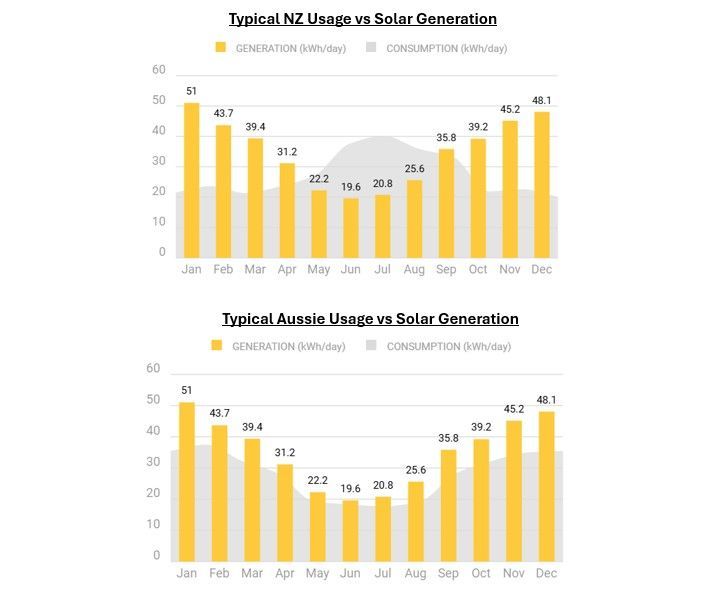
If you're not home during the day, but able to heat some hot water (or a spa pool), you'll probably use about 35% of the solar - without a battery.
The savings are tied directly to your power rates. in 2026, kiwis are paying about 36c for power, plus GST.
- 35% of the solar equates to some free power for the home owner! About $1,550 in savings for the year.
- (35% of 10,700kWh multiplied by 41.4c).
And how about the rest of the solar? The energy that the home doesn’t use?
Well, the power company buys it from the home owner.
As at Feb 2026, Genesis pays 12.5c. Powershop pays 13c. Meridian pays 17c. Ecotricity pays 21c at peak times. Octopus pays 40c at peak times in winter.
So, let’s take a conservative average of 18c.
- 65% of the solar gets bought by the home owners power company!
- Solar buyback credit - $1,250 over the whole year.
- These ‘solar buyback credits’ are applied directly to their energy bill.
- (65% of 10,700kWh of solar generation, multiplied by 16c).
Savings come in the form of free power, and solar buyback credits.
Adding the buyback credits above of $1,250 and the free power of $1,550 we're looking at savings of $2,800 per year, without a battery.
Conservative estimate of savings without a battery:
Spend $14,000 to save a total of $2,800 annually.
Assuming no inflation, the payback period is around 5 years.
Adding a battery, conservatively:
Spend $24,000 to save approximately $3,500 annually.
Assuming no inflation, the payback period is 8.57 years.
More on how batteries increase your savings
Most kiwi’s think solar isn’t worth having if most of the energy gets sold to their energy retailer.
But as seen above, even if you're selling 65% to the retailer, solar is a no brainer!
In fact, some solar companies make it their main sales pitch. “You must get a solar battery… Selling power to the grid is worth pennies… Don’t waste your money on solar without a battery…”
But we beg to differ.
Hear us out.
Batteries save you more money by storing energy during the day, to use it at night; or on a cloudy afternoon.
But how much more? Is it a lot more? A little more?
The answer is….
A LITTLE MORE.
How a Battery saves you a little more
Now, let’s talk about how a solar battery could save you a little more.
The idea is: If your power company buys back energy at $0.16/kWh, and your rate is $0.38/kWh, a battery saves you the difference:
- $0.33 - $0.15 = $0.22 per kWh stored
- For a 12kWh battery costing $15,000, storing and discharging an average of 10kWh/day would save you about $2.2/day—or $803/year.
- A 12kW solar battery should cost you about $15,000.
- At that rate, assuming no inflation, it would take 19 years for the battery to pay for itself.
- Good batteries are expected to last 15 – 20 years, but are only warranted to have a capacity of 60 – 80% at year 10.
You can save more by charging your energy off the grid during off-peak times
Many solar companies are selling the benefit of charging your battery when power is cheap, and discharging when power is expensive. This is a great idea! But -most batteries only allow 1 full charge and discharge per day in the terms and conditions of their warranty. So - if you 'trade' energy, you may void your warranty. But faster battery degradation is a certainty once you start trading energy.
Also - if you buy at 20c and consume during a period where your peak rate is 45c, the benefit is 25c.
12kWh x 25c = $3 a day.
Is it worth trading energy, to save a maximum of $1,095 per year, if its going to decrease the life of your solar battery by up to half?
The life expectancy of the battery is about 15 years. If it ends up lasting only 8, because you've earned an extra $1000 per year from trading energy, is it really worth it?
If you want a solar battery, we’ll help you get a great one!
And we’ll be incredibly transparent with you on the savings and payback.
We’re not saying ‘don’t get a solar battery.’
We’re simply providing a framework for you to evaluate the cost and benefit.
Is there another way? Can free power hours be utilized?
- Some energy retailers offer discounted power during the night hours.
- Most batteries let you set charging and discharging times, so you could charge your battery during these times.
- While these plans often come with higher daytime rates, solar users don’t buy much daytime power anyway—so the savings can add up.
- We can help you model this to see if it’s worth it for you.
Is It Safe to Charge a Battery at Night?
Many of our clients raise concerns with battery safety. They wonder if their battery will catch fire.
Fact is, the risks are minimal, almost zero. There’s definitely more risk that a cheap phone charger from Temu will cause a fire in your home.
However… While the risks are practically zero, there is still a risk. So, here’s the real question:
Are you comfortable having a battery charge at full capacity while you’re sleeping?
Your answer depends on your appetite for saving money, and the risks you're willing to take for an extra penny!
Conclusion: Should You Get a Solar Battery?
We’re not saying “don’t get a battery.” But it’s important to weigh the costs and benefits carefully.
If energy resilience matters to you—or if you want to explore all the ways to save—we’ll guide you every step of the way.