Is solar a no brainer? 🤔


*This is an article for residential buyers.


Out there in the marketplace, there’s a ton of articles breaking down the reasons why people consider solar for their home or business.


Speaking to hundreds of solar buyers, we’ve identified that most people want to contribute to a cleaner & greener environment, but generally only proceed with solar when the value enters the ‘no-brainer’ category.


So, I guess the question is; what counts as a no brainer investment?


There are two angles here, buyers using home equity and buyers using cash.

Sorry to make it black and white, but this is the reality of it.


In this blog, we’ll talk about the buyers using home equity, or alternative funding such as Q-card or Gem-Visa, as offered by a few solar providers (note; the latter funding methods aren’t home-equity loans, but the buyers evaluate the options through similar lenses).  


So, what it is? What defines a no brainer?


Keeping it simple, and in one point only, our clients have made it very clear that cashflow is the primary consideration. Minimal or no impact to cashflow is what buyers are looking at.


How can you achieve minimal or no impact to cashflow?


Option 1.


Get a solar system without a battery, maximising savings on a great power plan with huge solar buyback rates. (Consider the likes of Meridian or Powershop).
 
With massive buyback credits, and replacing up to 50% of your homes annual energy use with sunshine, you’re likely to achieve a solar system that pays for itself in 5 to 8 years. Say, 12 – 15 panels would be ideal for most homes.
 
IE; spend $12,000 now and save $2,000 per year. This amount of savings, divided into system cost, works out at about a 6-year payback.


The repayments on a loan with 0% or 1% interest, on a 5-year term, would only be marginally higher than the average monthly solar system savings.


Considering a 1% loan, over a 10-year period (ASB, ANZ, and BNZ offer this).  The repayments are $205 per month. The solar savings would be an average of $166 per month. So, the difference is $39 per month.


Is that a no brainer? $39 a month for a solar system with 12 - 15 panels?


Maybe yes… Maybe not… Some people would say it’s not. And that’s OK.


But, hold the line caller…. Power prices are going up a ton right now, with energy markets forecasting rates may double in the next 10 years. That’s an annual inflation of over 5%!!!


Assuming 3% power inflation, when power prices increase for our hypothetical buyer, they’ll save another $60 next year. And then $62 more the following year. Then $64!!


The $39 monthly cost, or cashflow impact, reduces annually respective to power price increases.


Maybe that’s a no brainer? You decide.


Option 2.


Still get a system without a battery, and let’s assume the same size and same price.


Obtain a ‘mortgage top up’ loan from your bank, with a longer term such as 10 years.
People get these all the time for cars, boats, and holidays.
 
So, you can get a 10-year term, and if you’re with ANZ or BNZ, the first few years will have an interest rate of only 1%!!!


1%... What do the repayments look like now…


A $12,000 solar system work out at $105 per month. One Hundred and Five.


But the system is saving an average of $166 a month.


So… … … You’ve got cash going into your pocket immediately. 
$61 of cash per month, as an average.

*It’s actually more like $80 in summer and $35 in winter.
*Summer bills usually drop by 70%, and winter by about 30%.


Do you see the picture?
 
You can take a 10-year loan, and the system puts money in your pocket. 


Maybe that’s a no brainer, I’ll let you decide.


But wait, what about when interest rates go up?


If interest rates go from 1% to 6% in the fourth year, will that negate the cashflow benefits?

The answer, in simplicity, is, no.


If power prices go up by more than 5% within 3 years, your savings from the solar will have gone up respectively. Increased interest costs are likely to be wiped out by increased solar savings.


If it sounds complicated, engage an Equity Solar Broker. 🙌


Equity Solar Broker’s ensures you get the ideal solar system, for the ideal price, by mutually exploring what’s right for your home, and then procuring the apples-to-apples quotes on your behalf.


Getting solar has never been easier.


*We aren’t financial advisors, but we’re good to talk to, and we have a great relationship with some top-notch financial advisors.


Much love.


Rowan Ellis | Founder

Equity Solar Broker’s

rowan@equitysolar.co.nz


By looka_production_130270016 March 19, 2026
Because supply and demand is the guiding principal behind prices in every market...
By looka_production_130270016 February 7, 2026
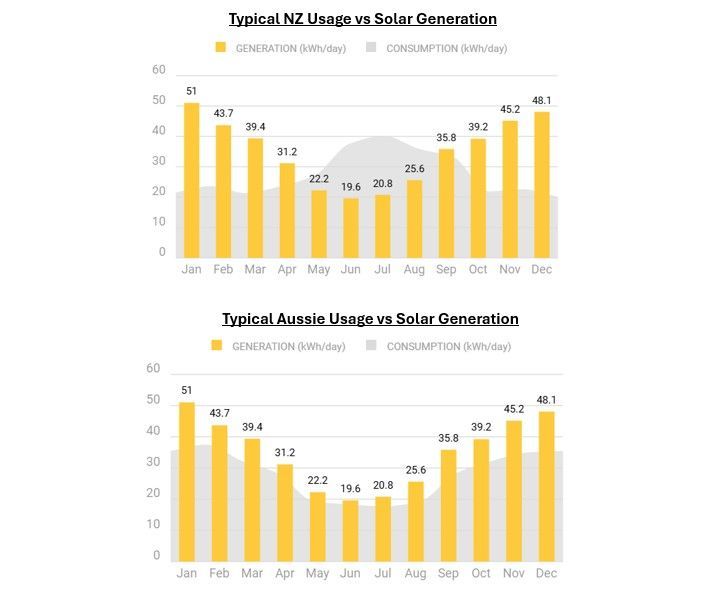
Why We Can’t Size Solar Batteries Like The Aussies Do Most kiwis want solar to reduce their power bills, and mostly – their winter power bills. And most Kiwis tell us – “We want a solar system that charges up the batteries during the day so that we can heat our home at night.” News flash: Yeah........... Sorry - that’s not going happen aye. Here’s why. Everything You’ve Heard About Sizing Solar & Batteries Is Probably Wrong (For NZ) When you jump online and search about solar, you’ll find information from Bloggers and YouTubers in parts of the world with entirely different energy demand patterns. Think about Australia for a second. 99% of homes in Aussie use tons of power in summer, which is conveniently when they generate the most solar. Our clients often come to us with the idea that solar + battery means very little grid use with the potential for 'off-grid in the city'. In Aussie, that's almost possible! But not here, because most kiwi homes use more power in winter, than in summer - which is inconveniently when solar systems produce ~50 to ~70% less. We’re left with two conundrums: in summer, you can’t make the most of a big battery… and in winter, you can’t charge one. Batteries Should Be Sized According To Your Spare Winter Solar This is the main point. Read the rest of the blog for more insight. ‘Nuf Said. You Won’t Discharge A ‘Uge Battery In Summer Let’s say your solar system generates ~40kWh per day in summer – (typical for a 20 panels system). But your home uses ~25kWh per day. There’s a 15kWh difference between what your home uses, and what you’re generating. So if you don’t need that spare energy, what’s the point in storing it? * Whether you have a huge battery or not, if your home doesn't use the spare solar, you'll be selling that 15kWh for about 17c per unit, which adds a $2.55 credit to your power bill EVERY day. You Don’t Need Much Storage In Summer If your home uses ~25kWh on a typical summer day, the question is: how much of that energy demand occurs after the sun goes down? ‘Cos the reality is – most homes don’t use much at all. After 8pm in summer: … You’ve done the cooking … Used a bit of aircon in the arvo … Your hot water’s steaming … The beers are cold … And your TV uses 100w So on a 25kWh day, your home might only pull ~10kWh between 8pm & 8am. … So, with these rough summer calcs, with 20 panels, most people can only make the most of a ~10kWh battery. C’mon – Surely It Makes Sense To Have A Big Battery In Winter? Yeah, I know that’s what you’re thinking. Everyone thinks that. You get home from work... Crank the heating till 11pm, and then ‘sip’ the heating until everyone leaves the next morning. So of course, you need a big battery to power all that heating. But wait… Solar Sucks In Winter - Sorry ‘bout it. That system we spoke about, those 20 panels; they’ll generate about 40kWh on a typical summer day. But in winter, you’ll be lucky to get 30kWh. But most homes don’t have a 35 degree north facing roof. So 20 panels generate closer to 20kWh per day. And this hypothetical home we’ve been talking about (that uses 25kWh per day in summer), probably pulls 50kWh per day in winter. And of that 50kWh, 15kWh is probably pulled during the 9 – 5. Fridge, freezer, hot water heating, maybe a spa – whatever it is – even with nobody home, there’s still power use during the day. So, shit – of the ~20kWh these 20 panels are spitting out, more than half of it is chewed up by the homes base loads. The difference goes into the battery. And what’s the difference here? ‘Bout 10kWh, if you’re lucky. … So even though the house uses 50kWh per day in winter, there’s no point having a battery bigger than ~10kWh. It simply won’t get charged. You’re The Worst Salespeople Ever No, we’re not. We’re just saying it like it is. In summer, you couldn’t possibly use all of your solar. And in winter, you couldn’t possibly charge a huge battery. But you can still save a shit ton with solar. And the good news is, you don’t even need a battery to eliminate most of your summer bills. Read this . And this . And watch this. But if you want to reduce your winter bills, you’re going to need a battery. If it adds a year or two to your solar-system payback period, it’s nothing in the scheme of things. Especially when you consider the blackout experience. (Its awesome these days)! So, What Do I Do? Prioritize north, if you can. A north roof with a pitch of 15 to 45 degrees is ideal. North produces the most energy in winter, which gives you the best hope of charging a battery. If your roof has some north, and a bit of something else – prioritise north AND west. We love west, because west produces energy until the summer sunset, which is when you might want to cool your home. If your roof is East and West; look very closely at the winter production estimates, because most east-west systems struggle to charge even the smallest batteries in the 3 coldest months of the year. You Didn’t Answer My Question – How Much Storage Do I need? … Sorry, here’s the framework. Subtract your winter day time energy use from your winter solar production. The answer reflects the size of battery you should consider. You could buy a little more, but again – consider your summer evening loads, and ask yourself – do you want to spend a few grand extra (or more); just for it to be a pretty box on the wall providing little financial benefit? Does Equity Solar Brokers Support Solar Batteries? Heck yes we do! We love seeing our clients get batteries. About one third of them get batteries with their solar purchase. We’re not against batteries. We are obsessed with helping kiwis get a great return on their investment. We achieve that through smart solar system design and anonymous quote procurement, which is our leverage to getting sharp solar quotes. Everyone has a different solar objective - and we're all ears. Can't wait to hear yours. In a time of rising power prices and grid instability, batteries are awesome. And guess what – we’ve never had a client regret buying a battery. One client called to tell us they had a 2-day powercut, but only found out when the neighbors swung by. Priceless. Need a hand with system design? That’s what we do best. And we’ll get you the best quotes in the market while holding your hand every step of the way. Chuck your deets below, and lets do this.
By looka_production_130270016 January 24, 2026
Before your details are shared with a solar company, here’s what you should know about what happens next — and why this process doesn’t move at Uber Eats speed.