
The Biggest Mistake People Make When Looking At Solar Payback Periods
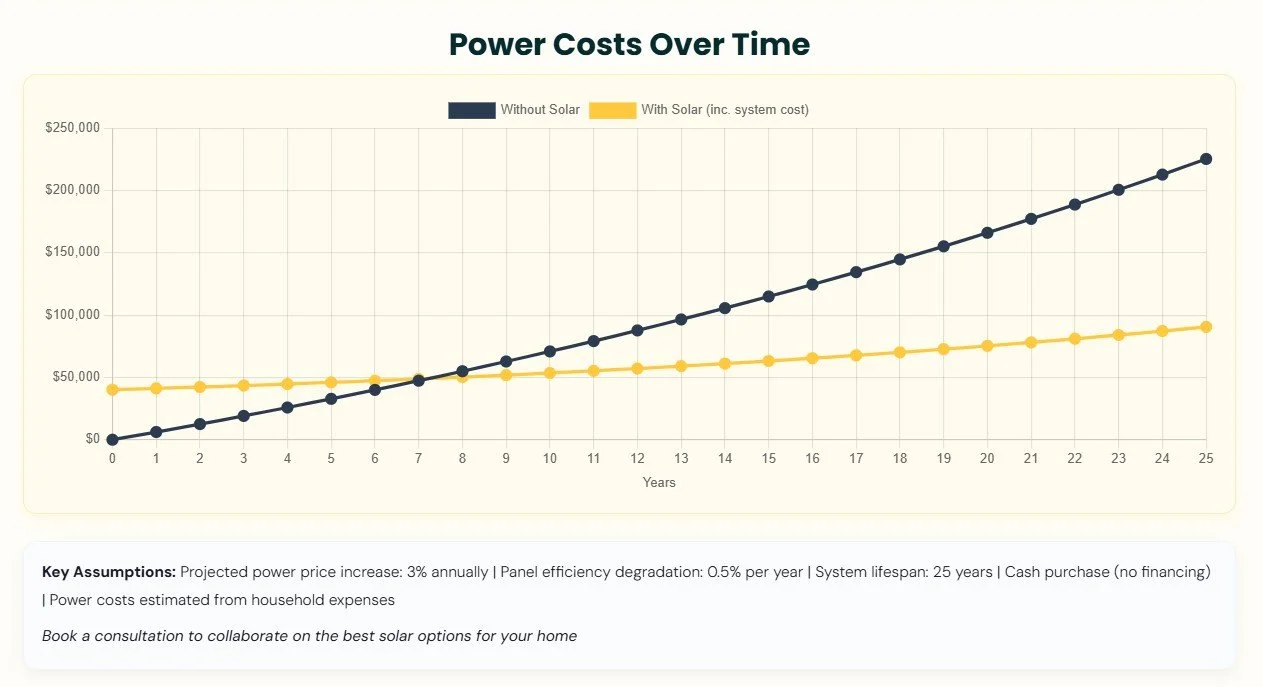
These charts are straight out of our combined solar savings and financing calculator.
Most homeowners spend 30 seconds looking at this graph.
And almost all of them make the same mistake.
Their eyes go straight to Year 7.
Mine go straight to Year 25.
The Payback Period Is The Least Interesting Part Of The Graph
Imagine buying a rental property.
You ask:
"How long until it pays for itself?"
Someone says:
"Seven years."
Would you then ignore the next 18 years of rental income?
Of course not.
Yet that's exactly how most people think about solar.
They obsess over the moment the system pays for itself.
And completely ignore what happens afterwards.
In this example, the solar system pays for itself in roughly seven years.
Great.
But that's not the important bit.
The important bit is what happens between Year 7 and Year 25.
That's where the homeowner keeps generating electricity while power prices continue increasing.
That's where the savings really make their life long impact.
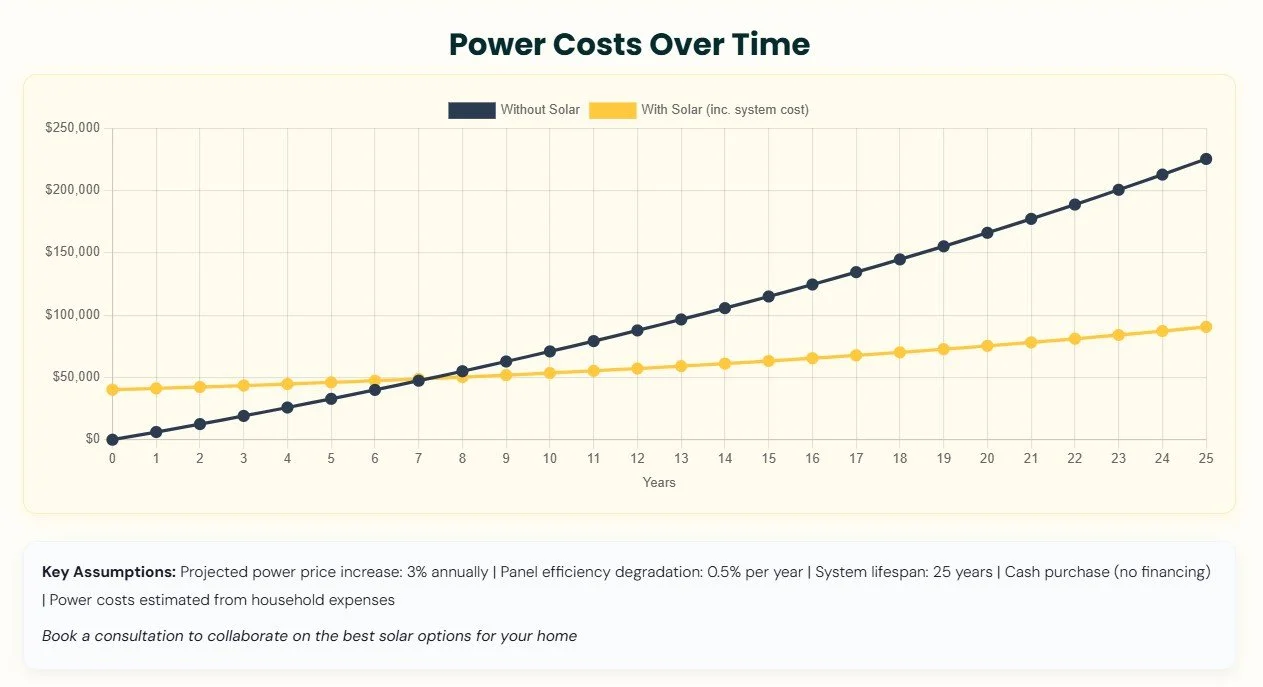
These charts are straight out of our combined solar savings and financing calculator.
Look at the same graph above.
The two lines cross at roughly year 7–8. That's the payback point.
Most people focus on that intersection.
We focus on everything to the right of it.
From that point onward, the solar system keeps generating electricity while the cost of buying power from the grid continues to rise. By year 25, the difference between the two lines is enormous.
That's why I don't get particularly excited by a payback period on its own. The payback point is just the moment the investment stops costing you money and starts making you money.
Once a solar system has paid for itself, you don't get a refund.
You get something better.
You keep the asset.
An asset that’s probably giving you a 20% return on what you initially paid, even though it was only giving you a 12.5% return when you go it.
As power prices rise, the savings rise. Like owning a good stock with a growing dividend.
"But I Don't Have $25,000..."
Fair enough.
Most people don't.
That's why a lot of homeowners choose to finance part—or all—of their solar system.
The interesting thing is this...
If the repayments are close to (or lower than) the savings on your power bill, you're not necessarily waiting eight years to benefit.
You're simply redirecting money that was previously going to your electricity retailer into paying for an asset you actually own.
And that’s totally possible. See the graph below - it depicts a loan for solar at 5.5% from the bank, over 10 years.
But guess what, some banks will only charge you 1% for the first 3 years 😎
Once the loan is fully paid repaid, the savings become infinitely more noticeable because the solar system keeps producing electricity long after the loan has finished.
That's why we model financed systems as well as cash purchases.
Not because finance is right for everyone...
But because it helps people compare the long-term cost of doing something against the long-term cost of doing nothing.
The graph below is one of my favourites.
Notice something interesting?
Around Year 10, the finance repayments stop.
The solar panels don't.
They just keep quietly generating electricity for another 15-20 years.
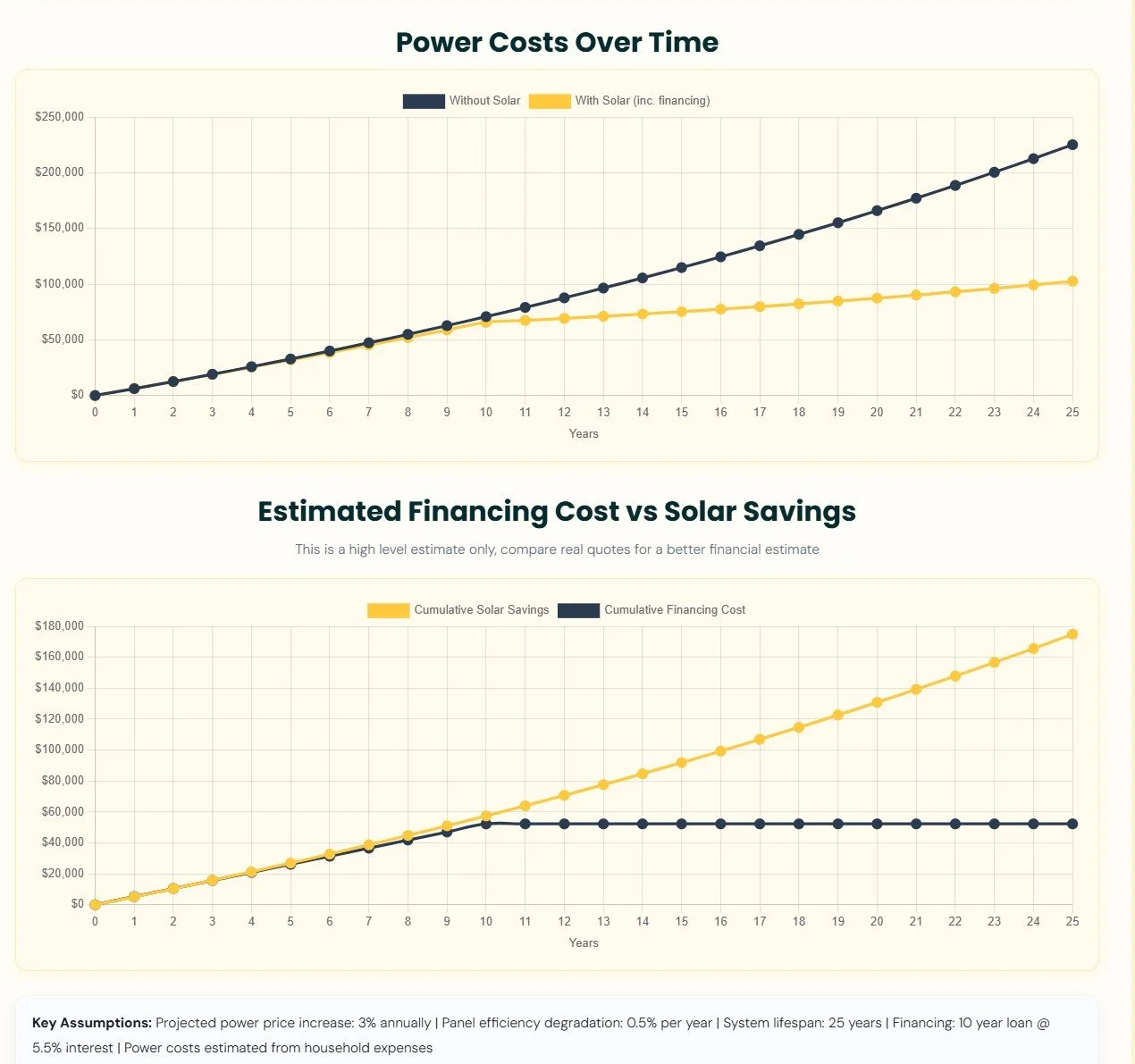
These charts are straight out of our combined solar savings and financing calculator.
Why We Show Lifetime Cost, Not Just Payback
Anyone can tell you a payback period.
We'd rather show you:
Your likely savings after 10 years.
The assumptions behind those numbers. (We assume 4.5% power price inflation, and 2.5% on the buyback rates. Much less than most solar companies).
Because payback periods answer:
"When do I get my money back?"
But homeowners should also be asking:
"How much better off am I after the system has paid for itself?”
The payback period is the starting gun, not the finish line.
And in our experience… that's when the investment really starts to shine
