Most Homeowners Don't Know What They're Buying... And Neither Would We
Almost daily, we meet a homeowner who's one signature away from buying a solar system they probably shouldn't.
That's not because they're careless.
It's because solar is one of the few major purchases where the products, pricing, and performance are almost impossible to compare.
You wouldn't buy a car without knowing whether you're looking at a Suzuki or a Lexus.
You wouldn't buy a TV without knowing whether it's a Veon or a Sony.
Yet every day, homeowners are handed three solar quotes and expected to make a $15,000-$50,000 decision based on a handful of brochures and a sales pitch.
No wonder people get stuck.
Add in the worlds most determined salespeople, AI-generated articles full of half-truths, and online platforms where everyone claims to be an expert, and suddenly the simple question of "Which quote should I choose?" becomes surprisingly difficult.
The reality is that every solar buyer has different objectives.
Some want the cheapest possible system.
Some want maximum savings.
Some want backup power.
Some are happy to pay top dollar upfront, because they know an extra five years of solid savings beats saving a few grand today.
A quote that's perfect for one homeowner could be completely wrong for another.
The problem is that most people don't have enough information to know the difference.
The Information Gap
Solar companies rarely provide fully itemised quotes.
You'll see a total price.
You'll see some product names.
You'll see some savings estimates.
But what you won't see is how much of that quote is being spent on the panels, the inverter, the battery, installation, warranties, support, or company margin.
Which creates a problem.
Consumers naturally compare totals.
"This quote is $3,000 cheaper."
"This one is $5,000 more expensive."
"This company seems cheaper than the others."
But without understanding the equipment, those conclusions can be completely wrong.
Take two popular hybrid inverter options.
A premium system like a Sigenergy might cost several thousand dollars more than a GoodWe, and that’s before you've even discussed batteries.
So if one quote is $3,000 more expensive, that doesn't automatically mean the installer is charging more.
It might simply mean you're comparing completely different equipment.
Unfortunately, most homeowners don't know that.
And frankly, why would they?
You don't buy solar every day.
Most Homeowners Don't Need More Information
Here's something we've learned after helping thousands of solar buyers.
Most homeowners don't actually need more information.
In fact, by the time they reach us, they're usually drowning in it.
They've watched YouTube videos.
They've read Facebook groups.
They've asked ChatGPT.
They've spoken to three different salespeople who all claim to have the best solution.
One says batteries are a waste of money.
Another says batteries are essential.
One says microinverters are the future.
One says Brand A is junk.
Another says Brand B is junk.
The problem isn't a lack of information.
The problem is a lack of clarity.
Most people don't want to become solar experts.
They simply want confidence that they're making a smart decision.
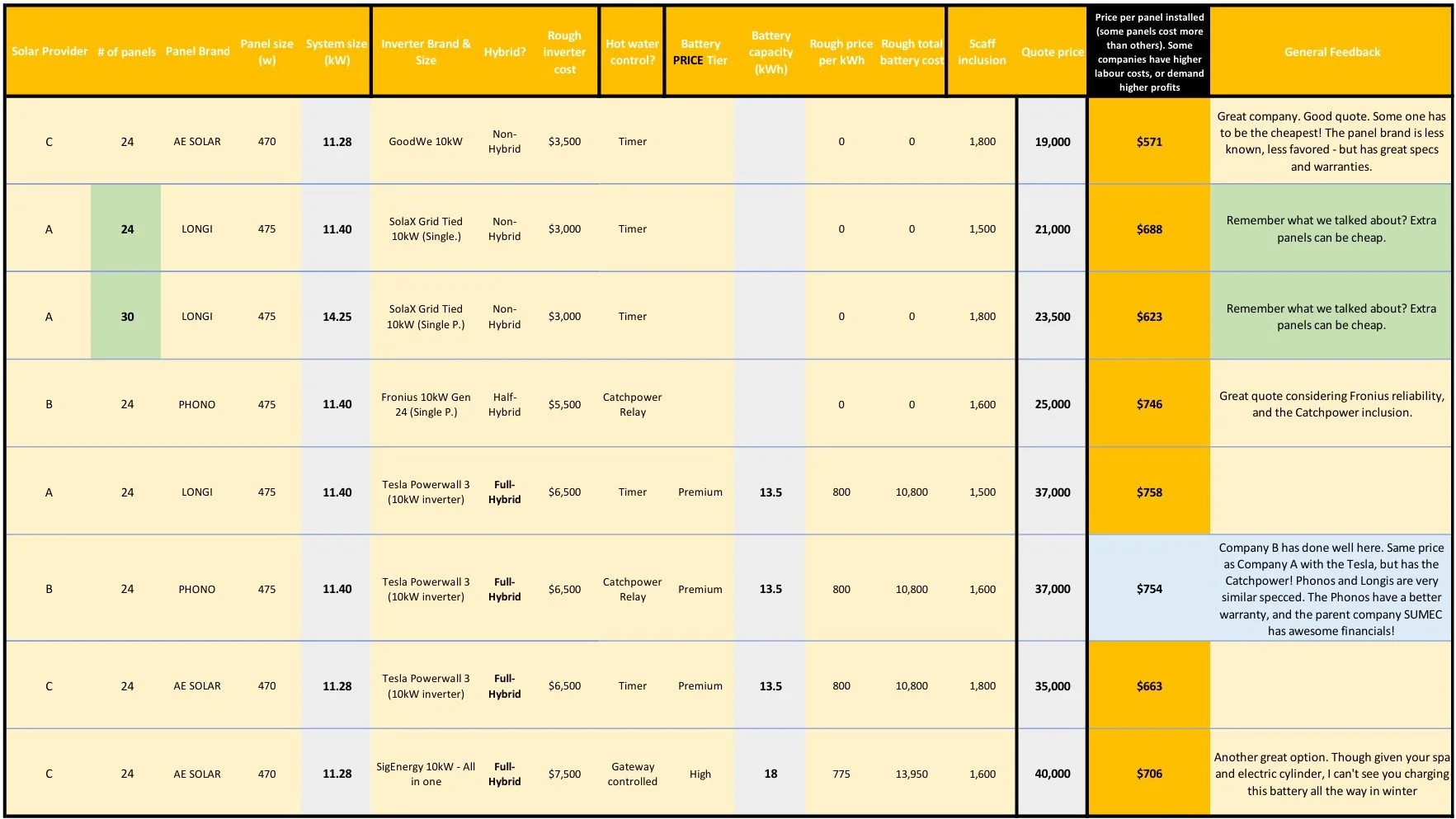
That's exactly why we built the Value Table.
Enter The Value Table
The goal isn't to overwhelm you with fifty pages of technical jargon.
If that's what you're after, you can always ask ChatGPT and enjoy a six-hour rabbit hole.
The goal is to make your purchasing decision easier.
The Value Table strips every quote down to the information that actually matters:
Number of panels
Panel wattage
Panel brand
Inverter brand
Approximate inverter value
Approximate battery value
Money spent on extras - like scaffolding or switchboard upgrades
The actual quote price
From there, we can quickly identify something most solar buyers never see:
What you're actually paying per panel installed.
It’s a rough guide, but its relative to the quotes in front of you.
Suddenly your options become much easier to understand.
Why We Use Price Per Panel Installed
At first glance, Price Per Panel Installed sounds overly simplistic.
And it would be if we simply divided the quote price by the number of panels.
But that's not what we do.
Before calculating the metric, we remove the major costs that could distort the comparison:
Rough inverter and battery pricing (and yes, this isn’t guesswork — we’re on the phone with solar companies weekly asking things like “what are you actually paying for the new Fox gear?”)
Scaffolding
Switchboard upgrades
EV chargers
Additional electrical works
Other project-specific inclusions
Those items are documented separately within the quote notes.
This allows us to isolate the actual solar system value and compare quotes on a much fairer basis.
Because a client shouldn't be left wondering whether one company is cheaper because they're more competitive, or because they've quietly omitted $3,000 worth of electrical work.
Once the noise is removed, Price Per Panel Installed becomes an incredibly useful comparison tool.
Suddenly it's much easier to identify which companies are pricing aggressively, which companies are charging a premium, and whether that premium is justified by better gear.
"Are These Panels Any Good?"
This is probably the most common question we receive.
"These two quotes both look great. But are Suntech panels any good?"
"What about LONGi?"
"What about Winaico?"
The funny thing is that the answer is often much less dramatic than people expect.
A premium solar panel doesn't cost ten times more than a budget panel.
In many cases, the difference between a good panel and a premium panel is surprisingly small compared with the total cost of the project. Like - in most cases there’s not even a $50 per panel difference at the supplier.
Often the cheaper quote isn't using bad equipment at all.
It may simply be using technology that's a generation older.
Maybe the efficiency is 22.5% instead of 23.5%
Maybe it doesn’t perform as well under shade. But… Who places their panels in the shade? 😅
That doesn't automatically make it a bad product.
Think of it like buying an iPhone.
Are you really worse off buying a new iPhone 15 instead of an iPhone 17?
For many people, probably not.
The important thing is understanding the trade-off.
Premium, Mid-Range, or Budget?
One of the questions we often ask clients is:
"What sort of products do you usually buy?"
Premium? Mid-range? Budget?
When buying a TV, some people happily buy a Veon.
Others will only consider Sony.
Neither person is wrong.
They're simply optimising for different things.
Solar is no different.
The challenge is knowing whether you're paying a budget price for a budget product, or a premium price for a budget product.
You don’t want to get ripped off. We save you from that.
Sometimes The Most Expensive Quote Is The Best Value
This is where things get interesting.
The cheapest quote isn't always the best value.
Sometimes the most expensive quote is your best bet.
Value sits somewhere in the middle of price, quality, performance, reliability, warranty support, and installer reputation.
Sometimes we'll see a quote that's $10,000 more, with the same number of panels and battery capacity.
At first glance it looks ridiculous.
Then we unpack it.
Perhaps:
$3,000 is premium panels
$5,000 is premium battery and inverter technology
$2,000 covers a highly regarded installer with an in-house installation team and an exceptional track record
Suddenly the premium makes sense.
Instead of asking:
"Why is this quote so expensive?"
You’re asking:
"Is it worth paying more for quality?"
That's the right question.
Why Brokers See Things Differently
Solar companies naturally see the world through the products they sell.
That's not a criticism. It's just the reality.
A company specialising in premium systems will naturally recommend premium systems.
A company specialising in budget systems will naturally recommend budget systems.
A broker sits in a different position.
We see quotes from dozens of solar companies.
We see equipment pricing.
We see market trends.
We see warranty outcomes.
We see which products are winning market share and which ones are quietly disappearing.
That perspective allows us to explain not just what you're buying, but why you're paying what you're paying.
And that's often the missing piece.
The Bottom Line
The goal of the Value Table isn't to find the cheapest quote.
The goal is to make sure you understand exactly what you're buying, exactly what you're paying for, and exactly why one quote may be better value than another.
Because the cheapest quote can be the best quote.
The most expensive quote can be the best quote.
What matters is understanding why.
Don't buy the cheapest quote without understanding why it's cheap.
Don't buy the most expensive quote without understanding why it's expensive.
And don't assume two systems are equivalent simply because they they have the same number of panels.
The solar industry is full of products, brands, warranties, batteries, inverters, sales pitches, and opinions.
What most homeowners actually need is clarity.
That's exactly why we built our Value Table.
Because when you understand what you're paying for, the right decision usually becomes obvious.
Want Your Quotes Turned Into A Value Table?
No quotes yet?
Use our FREE Solar Broker service.
We'll gather apples to apples quotes based on sound solar design principles, then provide insight and support to help you evaluate the options.
Already have multiple quotes?
Our $349: Quote Compare Service gives you independent, unbiased feedback on the quotes you've received.
Spend up to 60 minutes with us on zoom. We can go into as little, or as much detail as you like.
All your quotes in a value table. Unbiased insights. No sales pitch. No BS.
Get started by filling out contact us the form on our website and choosing the 3+ quotes option.