
Imagine you're buying a new ute.
You've got three options:
A Great Wall.
A Toyota Hilux.
A Ford Ranger.
All three have four wheels, an engine and a tray. They'll all get you to the hardware store.
But they're not the same vehicle. They don't have the same specifications, features, reputation or price tag.
And you'd probably be a little suspicious if someone told you that all three were worth exactly the same amount.
So why do people compare solar quotes as though every panel, inverter and battery is interchangeable?
The solar industry has a bit of a dirty little secret: the cheapest-looking quote isn't necessarily the cheapest installation. And sometimes, it's not even particularly competitive.
Let us show you what we mean.
A real-world example: three solar quotes, three very different propositions.
We recently helped a homeowner review a solar proposal they were seriously considering accepting.
The quote looked competitive. It included a substantial solar system, a hybrid inverter and battery storage. On paper, it seemed like a pretty good deal.
But we decided to dig a little deeper.
For this particular comparison, let's use a ute analogy to explain the equipment positioning:
Solar equipmentOur ute analogyDeyeGreat WallGoodWeToyota HiluxTeslaFord Ranger
Now, we're not suggesting these manufacturers are literally equivalent to vehicle brands, or that every product in their respective ranges belongs in the same category. It's simply an illustration of the different product propositions in this particular comparison.
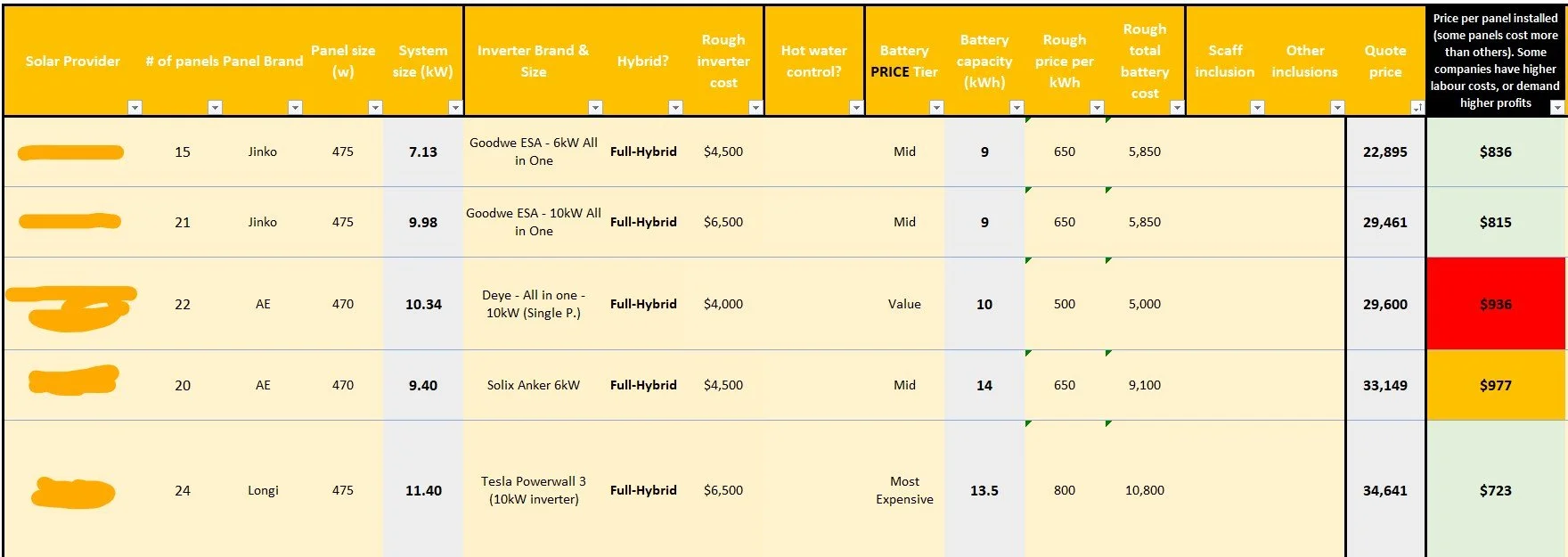
Here's what three actual proposals looked like.
Company A – The Great Wall
22 x AE 470W solar panels.
10kW Deye all-in-one hybrid inverter.
10kWh battery.
Total quoted price: $29,600.
At first glance, not bad at all.
The inverter and battery were assigned approximate equipment costs of $4,000 and $5,000 respectively in our comparison.
Deduct those estimates from the total quote and you're left with $20,600 for the solar panels, mounting equipment, installation, electrical work and associated costs.
That's approximately $936 per panel for the remaining portion of the job.
Suddenly, the bargain doesn't look quite so exciting.
Company B – The Hilux
Company B offered a different equipment proposition:
21 x Jinko 475W solar panels.
10kW GoodWe all-in-one hybrid inverter.
9kWh battery.
Total quoted price: $29,461.
That's just $139 less than Company A.
But the equipment package is different.
GoodWe is a well-established name in the solar industry, and Jinko is a major international solar panel manufacturer.
Using our approximate equipment costs, the inverter and battery account for $12,350 of the proposal.
That leaves $15,986 for the panels, mounting equipment, installation, electrical work and associated costs.
That's approximately $815 per panel.
So, for virtually identical money, the homeowner gets a different inverter and battery proposition, with a different panel package.
That's worth thinking about.
Company C – The Ranger
Then there's the premium proposition.
24 x Longi 475W solar panels.
Tesla Powerwall 3 (10kW integrated inverter).
13.5kWh battery storage.
Total quoted price: $34,641.
This is the most expensive proposal of the three.
But it also offers the largest solar array and the largest battery.
The Longi panels use back-contact technology, an interesting step up in panel technology when compared with conventional panel designs. The Tesla Powerwall 3 is also a premium integrated battery and inverter proposition.
Using the same comparison methodology, we estimate the inverter and battery component at approximately $17,300.
That leaves $17,341 for the remaining installation and solar panel component.
That's approximately $723 per panel.
Read that again.
The most expensive overall proposal actually has the lowest remaining price per panel.
So what does this tell us?
The point isn't that everyone should buy the most expensive equipment.
Far from it.
Deye has a place in the market. GoodWe has a place in the market. And Tesla has a place in the market.
The point is that you should know what you're paying for before deciding whether something is good value.
If you're paying nearly $30,000, you deserve to understand why one proposal costs what it does.
And if someone is selling you a budget equipment package at a premium installation price, you should probably know that too.
The panel matters just as much as the inverter.
There's another part of this comparison worth mentioning.
Not all solar panels are created equal.
Company A offered AE 470W panels. Company B offered Jinko 475W panels. Company C offered Longi 475W panels featuring back-contact technology.
They're all around the same wattage.
But wattage isn't the whole story.
Cell technology, efficiency, temperature performance, degradation, warranties and performance in shaded conditions can all influence the quality of a panel.
Two panels with almost identical wattage ratings can have quite different specifications and characteristics.
It's a bit like comparing two utes because they both have 150kW engines.
There's a lot more to the story.
This is why Equity Solar Brokers exists.
We don't install solar. We don't have a warehouse full of panels we're trying to move. And we don't have a particular manufacturer's equipment we're trying to sell you.
We're here to help you get the right system, at the right price, from the right installer.
We look beyond the big number at the bottom of a quote.
We compare equipment, installation pricing, system design, warranties, installer experience and the things that can make a real difference over the next 10, 15 or 20 years.
Because spending $25,000, $30,000 or $35,000 on solar is a significant investment.
You wouldn't buy a ute based solely on its price without considering what you're getting.
Why should solar be any different?
Don't just buy a solar system. Buy the right solar system, at the right price, from the right installer.
That's what we help you do.
Equity Solar Brokers
Simplify Everything.
